Measurement, Metric Conversions & Significant Figures
🎓 Florida Next Generation Sunshine State Standards (NGSSS) Addressed:
Table of Contents
- Lesson 1: The Metric System, SI Base Units & Derived Quantities
- Lesson 2: Reading Laboratory Instruments, The Meniscus & The Estimated Digit
- Lesson 3: Significant Figures: Rules & Calculating
- Lesson 4: Metric Prefix Conversions & Dimensional Analysis (Factor-Label Method)
- Lesson 5: Accuracy, Precision, Experimental Error & Quality Control
- Searchable Key Vocabulary Glossary (20 Terms)
- Master Model Answer Key & Step-by-Step Solutions
Lesson 1: The Metric System, SI Base Units & Derived Quantities
Every quantitative science is built upon measurement. When early civilizations traded goods, they measured length using human anatomy—cubits from elbow to fingertip, paces of marching soldiers, and grains of barley for weight. Because no two human bodies are identical, trade was chaotic, and scientific comparison was impossible. In 1795, French scientists established the Metric System, an elegant decimal-based framework derived from immutable properties of the natural world. In 1960, the international scientific community standardized this into Le Système International d'Unités, universally known today as the SI System.
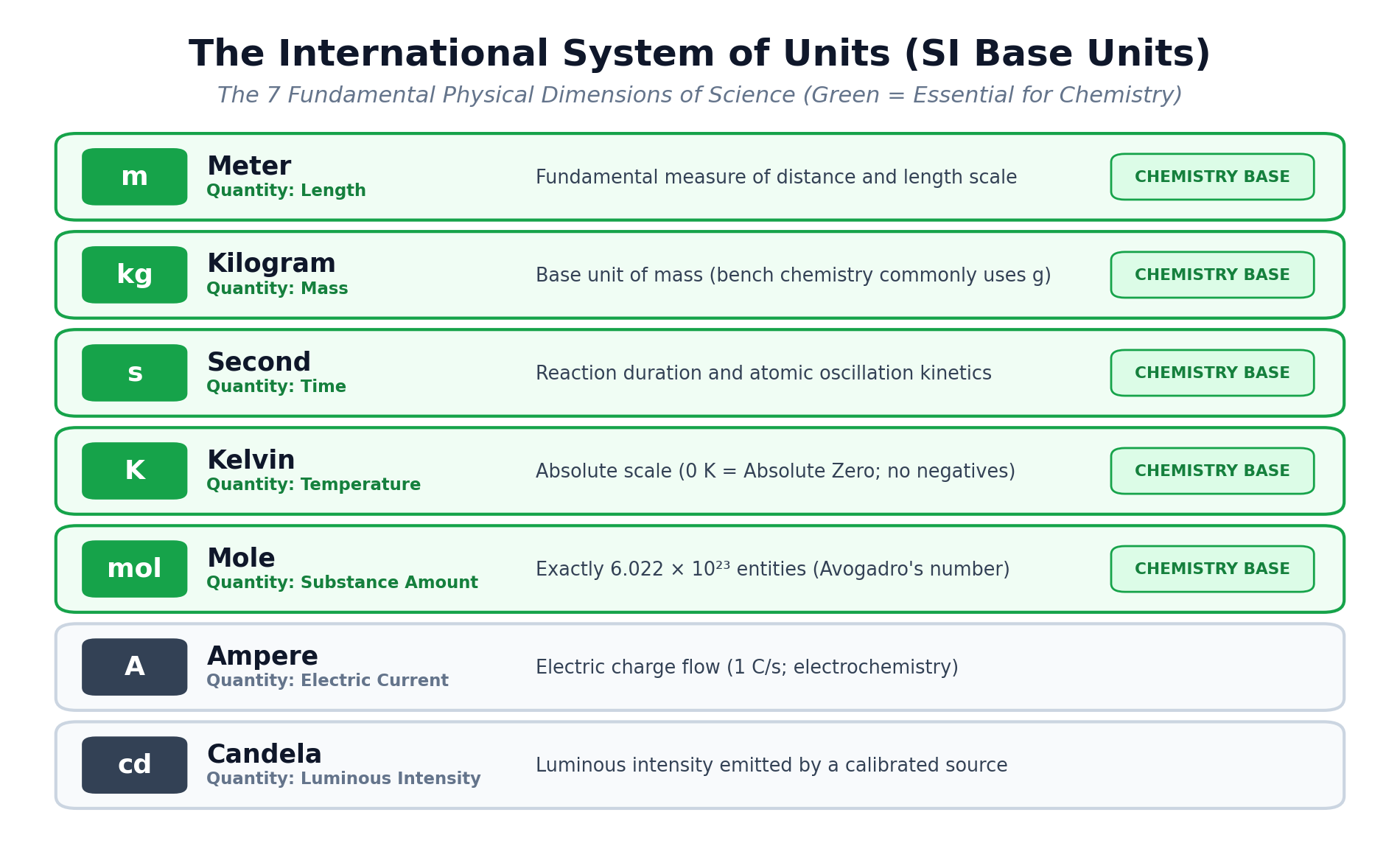
1.1 The Five Essential SI Base Units for Chemistry
In the SI system, seven fundamental quantities are defined as base units, meaning their definitions do not rely on combining other physical quantities. In Honors Chemistry, five of these base units form the foundation of our work:
| Physical Quantity | Base Unit Name | SI Symbol | Scientific Standard & Chemistry Application |
|---|---|---|---|
| Length | meter | m |
Distance light travels in vacuum in 1/299,792,458 of a second. Used for atomic radii (picometers, nm) and container dimensions. |
| Mass | kilogram | kg |
Defined via Planck's constant (h = 6.62607015 × 10⁻³⁴ J·s). Notice: The base unit has the prefix 'kilo'! In chemistry labs, we routinely work in grams (g), where 1 kg = 1000 g. |
| Time | second | s |
Defined by 9,192,631,770 transitions of a cesium-133 atom. Used to quantify reaction rates, half-lives, and molecular vibrations. |
| Temperature | kelvin | K |
Direct thermodynamic measure of average kinetic energy. Absolute zero (0 K = −273.15°C) is the lowest possible physical temperature where translational molecular motion stops. No degree symbol is written on Kelvins! |
| Amount of Substance | mole | mol |
The chemist's fundamental counting unit: contains exactly 6.02214076 × 10²³ elementary entities (Avogadro's number). |
In daily weather reports, temperatures can be negative (−10°C, 0°F). However, in the gas laws (such as PV = nRT or Charles's Law V₁/T₁ = V₂/T₂), temperature represents the average kinetic energy of moving molecules. Because kinetic energy cannot be negative, plugging a negative Celsius temperature into gas equations produces mathematically impossible negative volumes or negative pressures! To convert Celsius to Kelvin, we add 273.15:
1.2 SI Base Units vs. SI Derived Units
While base units represent standalone physical properties, most everyday chemical measurements involve SI Derived Units. A derived unit is created by algebraically combining two or more base units through multiplication or division:
- Area: Length × Width =
m × m = m² - Volume: Length × Width × Height =
m × m × m = m³ - Density: Mass ÷ Volume =
kg/m³or lab-scaleg/cm³andg/mL - Speed / Velocity: Distance ÷ Time =
m/s - Force: Mass × Acceleration =
kg·m/s² = 1 Newton (N) - Energy: Force × Distance =
N·m = kg·m²/s² = 1 Joule (J)
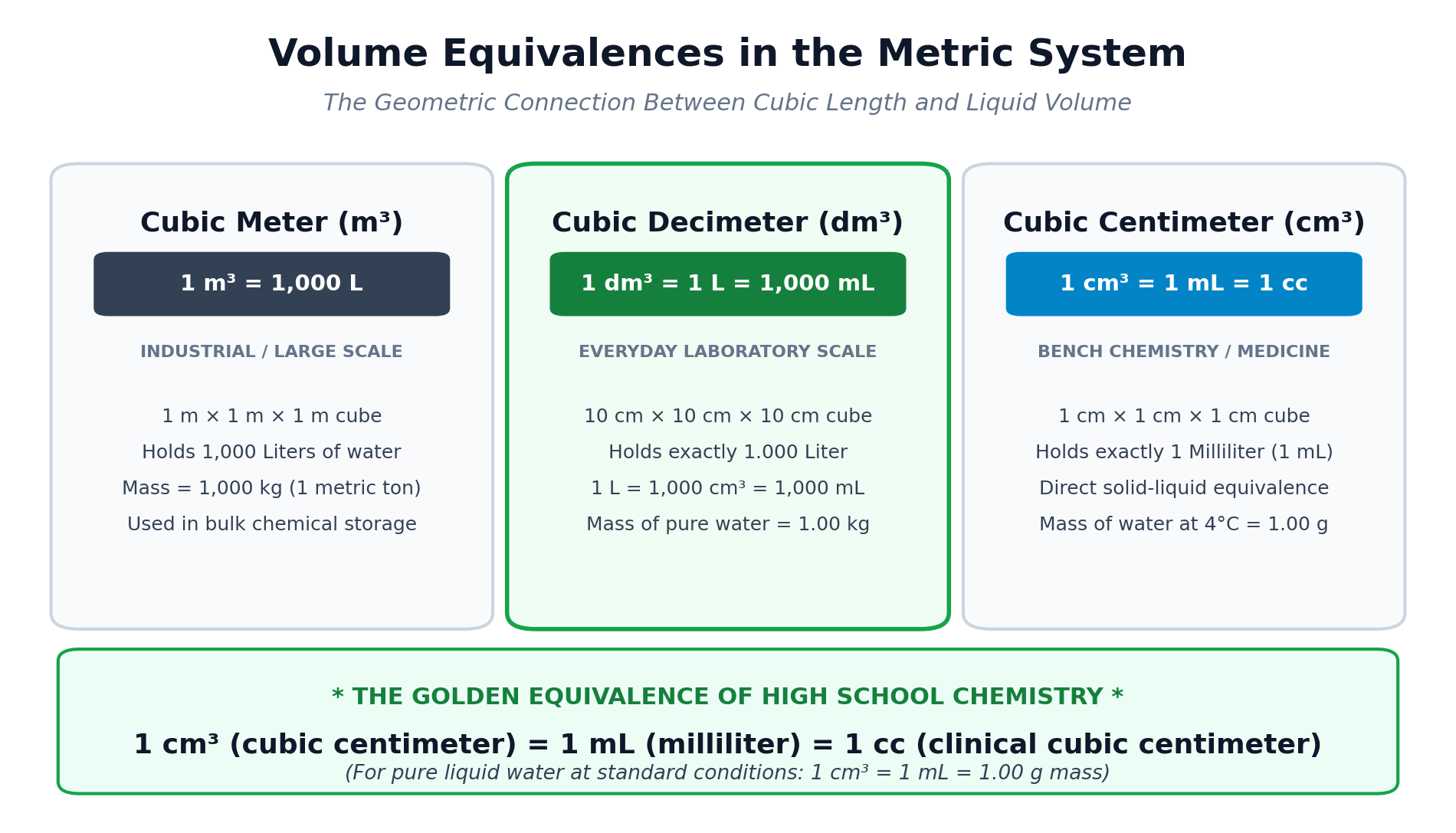
1.3 Essential Volume Equivalences Every Chemist Must Memorize
One of the greatest triumphs of the metric system is the direct geometric connection between length, cubic volume, and liquid capacity. In Honors Chemistry, you will use these three equivalences constantly:
| Equivalence Relationship | Physical Description | Common Laboratory Context |
|---|---|---|
| 1 cm³ = 1 mL = 1 cc | A cube measuring 1 cm on each side holds exactly 1 milliliter of liquid. | Medicine dosages (cc), solid density versus liquid volume, graduated cylinders. |
| 1 dm³ = 1 L = 1000 mL = 1000 cm³ | A cube measuring 1 decimeter (10 cm) on each side holds exactly 1 liter. | Solution molarity (moles of solute per liter of solution). |
| 1 m³ = 1000 L = 1,000,000 cm³ | A cube measuring 1 meter on each side holds 1000 liters of fluid. | Industrial chemical storage, environmental air sampling tanks. |
1.4 Density & The Water Displacement Method
Density is defined as the mass per unit volume of a substance. Because it depends strictly on how closely packed the atoms or molecules are and the mass of individual atoms, density is an intensive physical property. It does not change whether you have a microscopic shaving of gold or a massive bullion bar, making it an indispensable tool for identifying unknown materials.
For a regular geometric solid (like a rectangular block or sphere), volume can be calculated directly with calipers and geometric formulas. However, for an irregularly shaped object—such as an ore nugget, a metal bolt, or a rock sample—we employ the Water Displacement Method, first discovered by the ancient Greek scholar Archimedes.
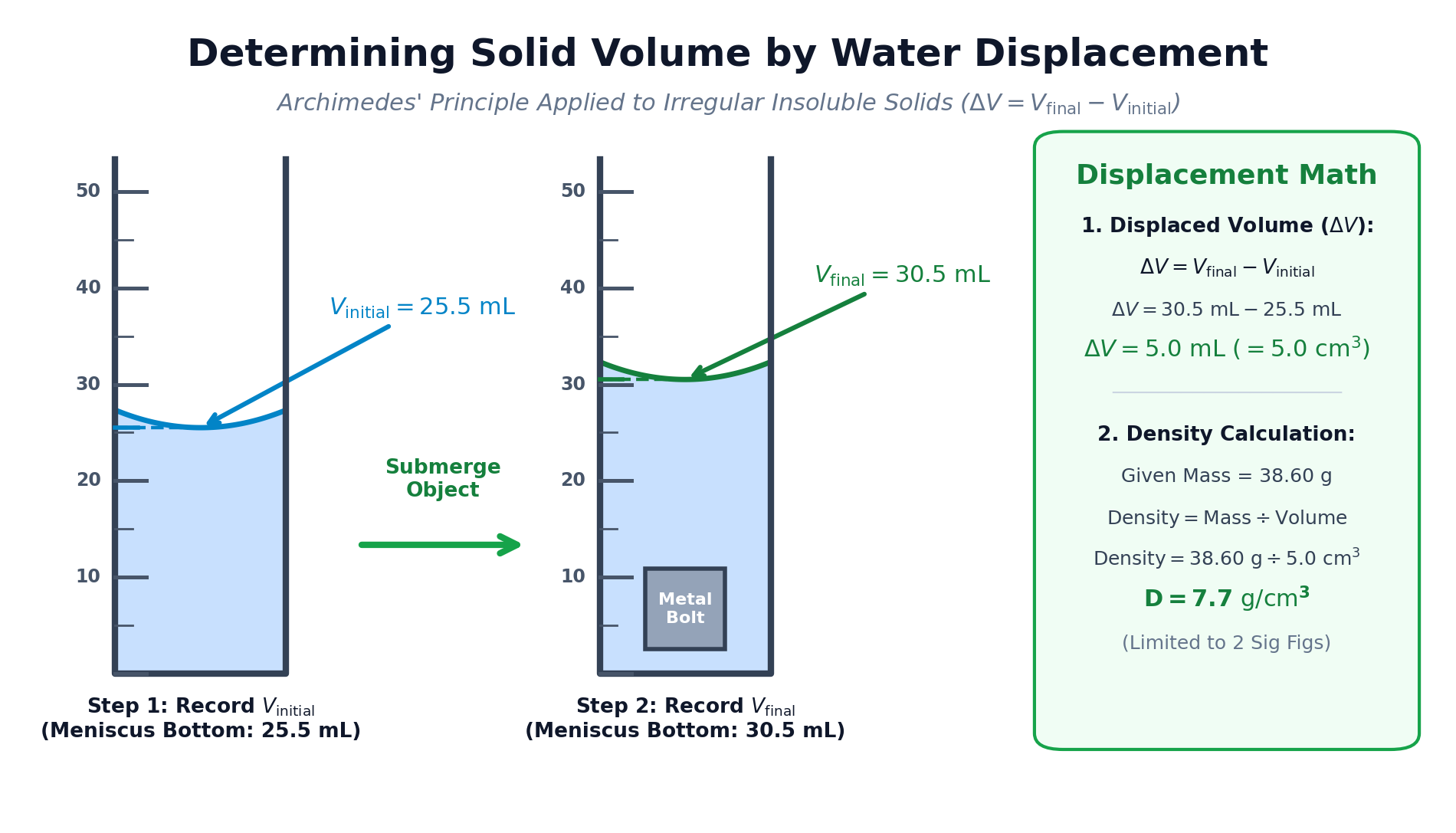
When an insoluble object is completely submerged in water, it pushes aside a volume of liquid exactly equal to its own physical volume:
King Hiero II of Syracuse suspected his goldsmith had kept pure gold and secretly alloyed his royal crown with cheaper, less dense silver. Archimedes could not melt the crown without destroying it. While lowering himself into a full public bath, Archimedes noticed water spilling over the brim and realized his body displaced an equal volume of water! By weighing the crown in air and measuring its water displacement, Archimedes proved the crown had a higher volume (and thus lower density) than a lump of pure gold of identical weight. The goldsmith's fraud was exposed through intensive physical property analysis.
 Professor Dave Explains • 3:50
The Metric System: SI Units & Prefixes
Professor Dave Explains the history, base units, and prefix powers of ten in the International System of Units (~4 min).
Practice Questions — Lesson 1
Formulate your answer to each question, then click "Show Solution & Explanation" to review the model solution and 2-line calculations.
Correct Answer: B) Meter.
In the SI system, the meter (m) is the defined fundamental base unit for length. Centimeter (cm), kilometer (km), and millimeter (mm) are metric-scaled units created by attaching prefix multipliers (10⁻², 10³, 10⁻³) to the fundamental base unit.
Apply the Kelvin-Celsius temperature formula:
Note: Because the initial measurement was known to the tenths place (23.5°C), the sum is rounded to the tenths place (296.6 K). Notice also that Kelvins do not use a degree (°) symbol.
Extensive properties (such as mass and volume) depend directly on the amount of matter in the sample. If you double the size of a sample, its mass doubles and its volume doubles.
Intensive properties (such as density, melting point, and boiling point) depend strictly on the substance's chemical identity and atomic arrangement, remaining completely independent of sample size. When mass is divided by volume (D = m/V), the size-dependence cancels out. A 1-gram fleck of gold and a 10-kilogram bar of gold both have a density of exactly 19.3 g/cm³, allowing positive material identification.
Part (a): Calculate displaced volume (ΔV):
Part (b): Calculate density:
Rounding Note: The volume has 2 significant figures (5.0 mL), so the quotient is rounded to 2 significant figures (7.7 g/cm³), consistent with the density of carbon steel.
Cubic meters cancel diagonally on 2 separate lines, yielding total capacity in liters. Limited to 3 significant figures.
Lesson 2: Reading Laboratory Instruments, The Meniscus & The Estimated Digit
In mathematics, numbers are abstract and purely exact. When you solve 2 + 2 in algebra, the answer is precisely 4.000... with infinite precision. In experimental science, however, no measurement is ever infinitely exact. Every physical tool—whether a wooden meter stick, an analog graduated cylinder, or an analytical electronic balance—possesses inherent physical limitations. Understanding how to extract the maximum honest information from an instrument without claiming false certainty is one of the most vital habits of mind in chemistry.
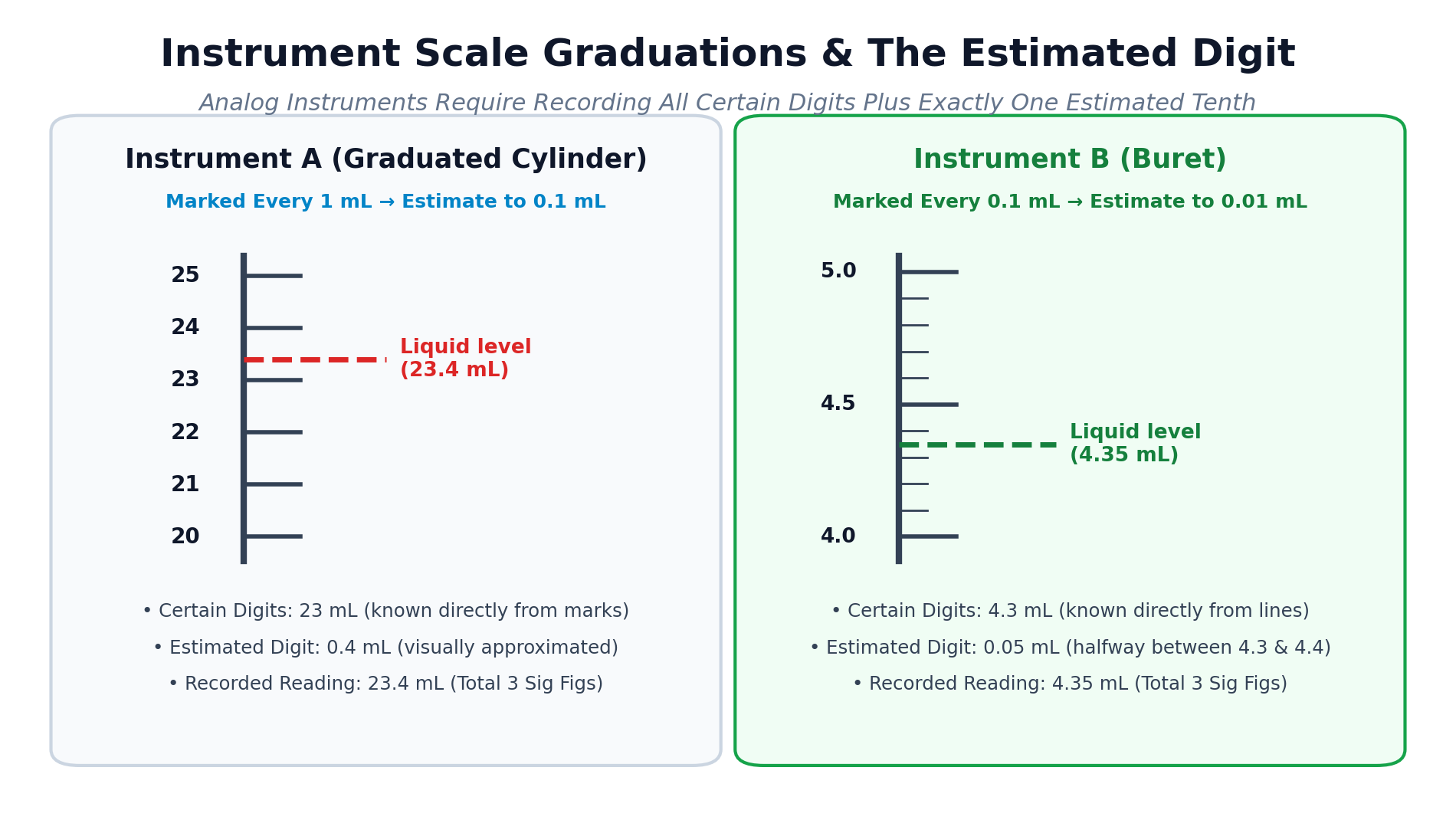
2.1 The Anatomy of an Analog Reading: Known Digits + Exactly One Estimated Digit
Whenever a chemist reads an analog (graduated) instrument, the recorded value must contain two distinct categories of digits:
- Known / Certain Digits: Digits read directly from marked lines or numbered graduations on the scale. Every observer looking at the scale will agree on these numbers because they correspond to physical markings.
- The Estimated Digit: Exactly ONE additional digit visually estimated by the observer between the smallest graduation marks. You mentally divide the space between the smallest markings into ten equal subdivisions and estimate the final digit (from 0 to 9).
The smallest marked divisions on an instrument determine its reporting limit:
- If a ruler is marked every 1 cm → Estimate to tenths: ±0.1 cm (e.g.,
4.3 cm). - If a ruler is marked every 0.1 cm (1 mm) → Estimate to hundredths: ±0.01 cm (e.g.,
4.37 cm). - If a 50-mL graduated cylinder is marked every 1 mL → Estimate to tenths: ±0.1 mL (e.g.,
25.4 mL). - If a 10-mL graduated cylinder is marked every 0.1 mL → Estimate to hundredths: ±0.01 mL (e.g.,
6.35 mL). - If a buret is marked every 0.1 mL → Estimate to hundredths: ±0.01 mL (e.g.,
18.42 mL).
2.2 The Crucial Estimated Zero: Why 25.0 mL is NOT 25 mL
One of the most frequent point deductions on chemistry lab reports involves omitting the estimated zero. Suppose a student measures liquid in a cylinder marked every 1 mL, and the bottom of the liquid rests exactly on the 25 mL line.
- If the student writes 25 mL, they are communicating that the 5 is the estimated digit, meaning the instrument was only marked every 10 mL and the measurement is somewhere between 20 mL and 30 mL!
- If the student writes 25.0 mL, they are communicating that the 2 and 5 are certain digits (read from lines), and the 0 is the estimated tenths digit (between 25 and 26). You must always record the estimated digit, even when it is zero!
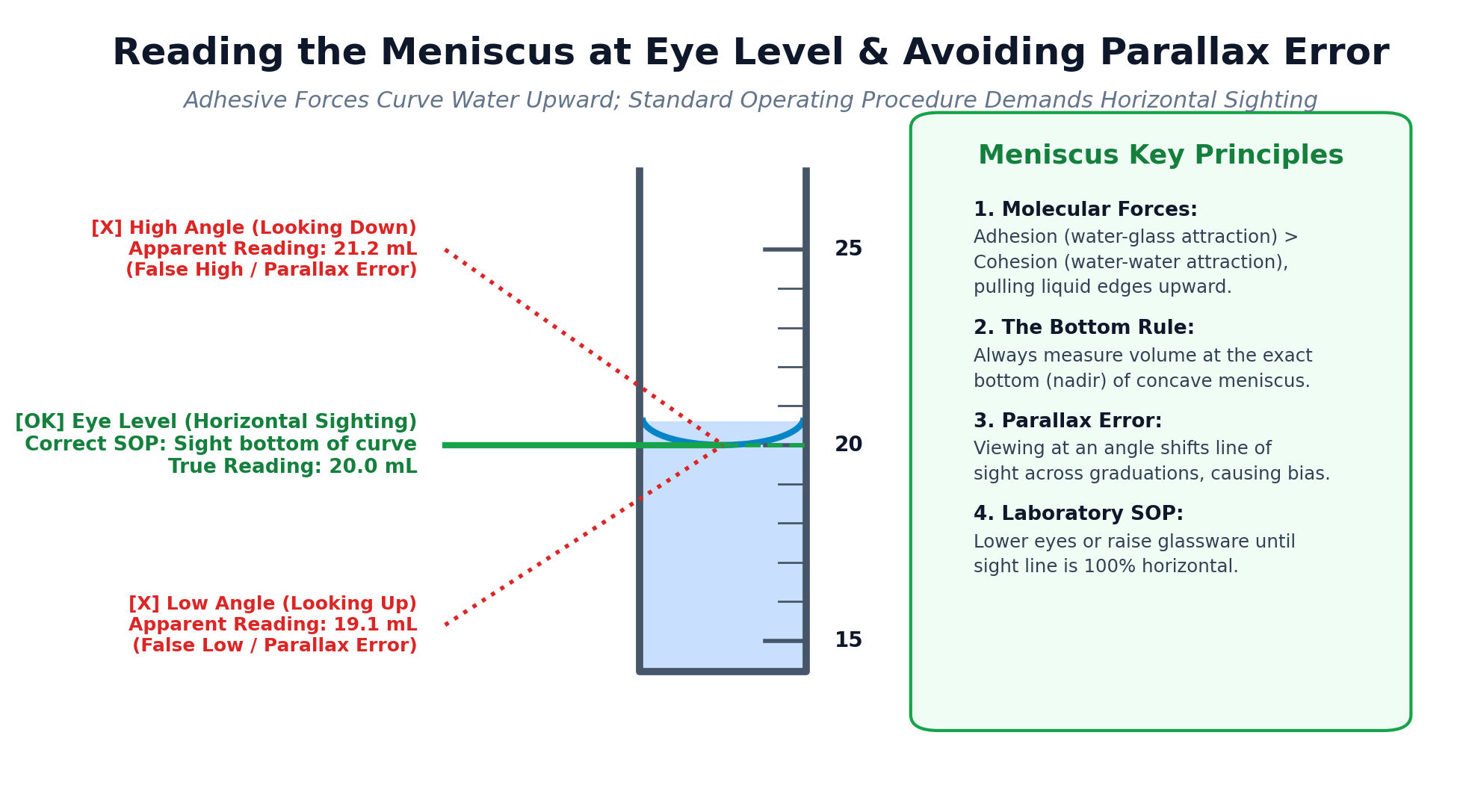
2.3 Physics of the Meniscus: Adhesion vs. Cohesion
When water is poured into clean glass labware, its surface is not flat. It curves upward at the perimeter, creating a curved concave surface known as the Meniscus. This phenomenon occurs because of two competing intermolecular forces:
- Adhesion: The attractive force between unlike molecules. Water is a highly polar molecule with partial positive and negative charges. Glass (silicon dioxide, SiO₂) contains polar silicate groups. Water molecules adhere strongly to polar glass walls.
- Cohesion: The attractive force between like molecules (hydrogen bonding between adjacent water molecules).
Because adhesive forces between water and glass are stronger than water's internal cohesion, water creeps up the glass walls, forming a concave meniscus. By international laboratory convention, liquid volume in a concave meniscus must always be read at the exact BOTTOM of the curved surface.
2.4 Parallax Error: The Necessity of Eye-Level Sighting
Parallax is the apparent shift in the position of an object when viewed from different angles. When reading a graduated cylinder or buret:
- Looking from Above (High Angle): The sight line angles downward, causing the bottom of the meniscus to project against a line higher up on the front scale. Result: The measurement is recorded falsely too high!
- Looking from Below (Low Angle): The sight line angles upward, projecting the meniscus against a lower mark. Result: The measurement is recorded falsely too low!
- Standard Operating Procedure (SOP): Bend down until your eye is in the exact horizontal plane of the liquid surface, sighting perpendicular to the glass scale.
 Professor Dave Explains • 7:22
Measurement and Significant Figures
Professor Dave Explains instrument graduations, certain digits, and reading the estimated digit (~7 min).
Practice Questions — Lesson 2
Formulate your answer to each question, then click "Show Solution & Explanation" to review the model solution and explanations.
(a) Certain digits: 1 and 8 (the 18 cm is read directly from marked whole-centimeter graduations).
(b) Estimated digit: 4 (the tenths digit, 0.4 cm, estimated between the 18 cm and 19 cm marks).
(c) No. A measurement may contain only ONE estimated digit. Reporting 18.42 cm claims knowledge to the hundredths place (±0.01 cm), which is impossible when the instrument is only marked to whole centimeters. That would represent claiming false precision.
The student must write: 42.0 mL.
Explanation: Because the cylinder has tick marks at every 1 mL, the student can read the 4 and 2 with absolute certainty and must estimate one place beyond the marks (to the tenths place, ±0.1 mL). If the student writes '42 mL', they have omitted the estimated digit, implying that the 2 is estimated and that the instrument was only marked every 10 mL!
In water, adhesive forces between polar H₂O molecules and polar glass walls (silicates) are stronger than the cohesive hydrogen bonds between water molecules (Adhesion > Cohesion). Water climbs the walls, forming a concave curve.
In mercury, the cohesive metallic bonds between mercury atoms are much stronger than the weak attraction between mercury and glass (Cohesion >> Adhesion). Mercury atoms pull inward toward each other to minimize contact with the glass, producing a convex (dome-shaped) meniscus. (Note: For mercury, readings are taken at the top of the dome!)
(a) Parallax Error (a systematic observational error caused by viewing a scale from an improper non-perpendicular angle).
(b) Systematically too high. When looking downward from above, the downward-angled line of sight projects the bottom of the meniscus against a higher point on the front graduation scale.
(c) Proper SOP: The student must crouch or elevate the cylinder so their eye is directly in the horizontal plane of the liquid surface, sighting perpendicular to the glass at the exact lowest point of the concave meniscus.
Because the smallest division on the buret is 0.1 mL, the observer must estimate one decimal place beyond the marks—to the hundredths place (0.01 mL).
The associated reading uncertainty is typically ±0.01 mL (or ±0.02 mL depending on user visual acuity). A properly recorded reading must always have two decimal places, such as 14.35 mL or 20.00 mL.
Lesson 3: Significant Figures: Rules & Calculating
When you enter 10 ÷ 3 into a pocket calculator, the screen fills with 3.333333333. Does that mean your laboratory measurement has ten digits of physical certainty? Absolutely not! A calculator is an unthinking mathematical processor; it has no knowledge of what tool you used to measure the numbers. Significant Figures are the universal protocol that prevents scientists from claiming more precision than their instruments actually provided.
3.1 The Four Universal Rules for Counting Significant Figures
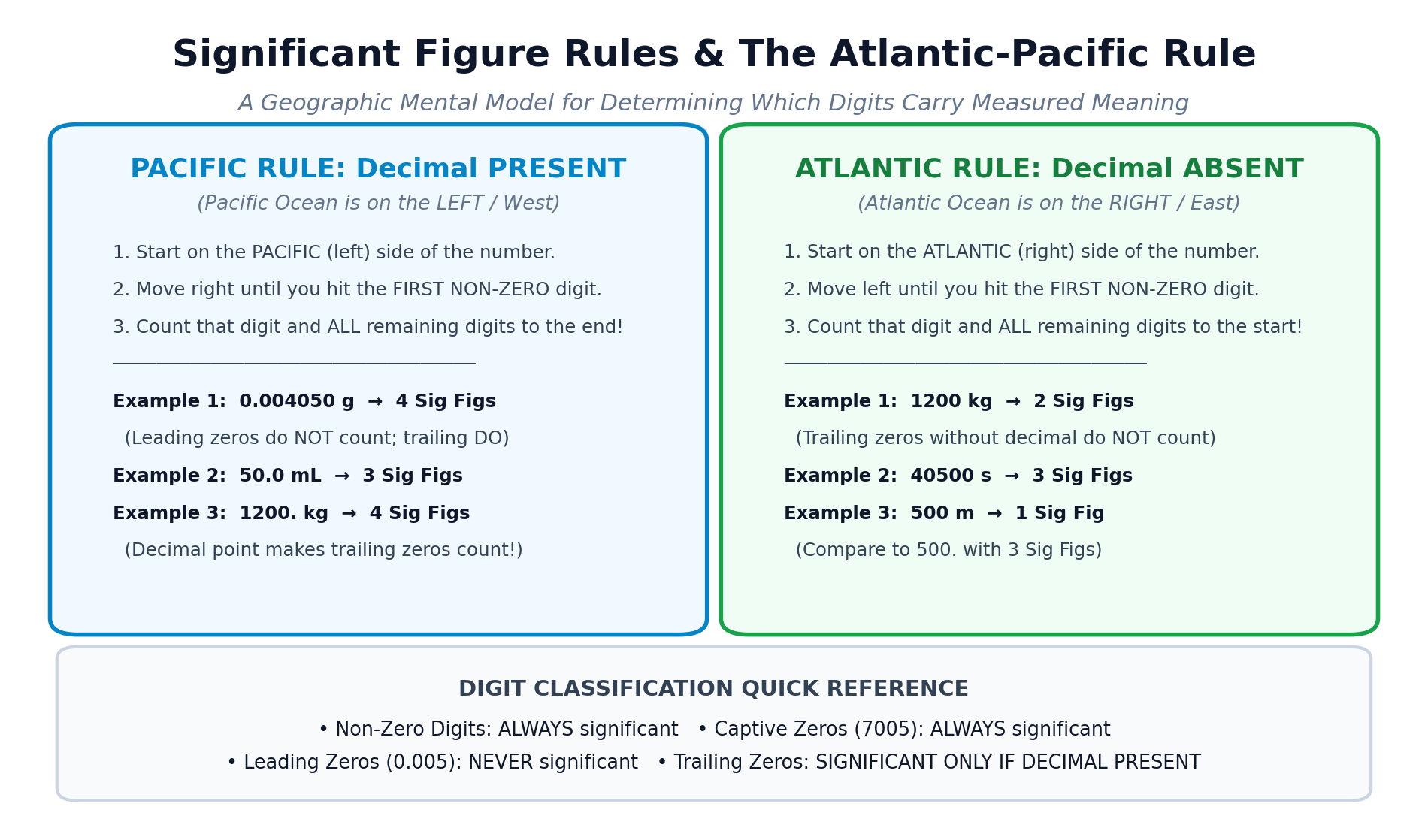
Every digit in a reported measurement that is physically meaningful counts as significant. When evaluating a recorded measurement, apply these four standard rules:
| Category of Digit | Rule Status | Clear Scientific Rationale | Illustrative Examples |
|---|---|---|---|
| Non-Zero Digits | ALWAYS Significant | Every non-zero number represents a physical quantity detected and recorded by the instrument. | 24.7 g → 3 sig figs1.895 m → 4 sig figs |
| Captive (Sandwiched) Zeros | ALWAYS Significant | Zeros between non-zero digits represent measured place values that happened to read zero on the instrument scale. | 7003 mL → 4 sig figs40.05 g → 4 sig figs |
| Leading Zeros | NEVER Significant | Zeros appearing before the first non-zero digit are mere placeholders that establish the decimal position. If you change units (0.005 g = 5 mg), the zeros vanish! | 0.00405 g → 3 sig figs0.02 m → 1 sig fig |
| Trailing Zeros | Significant ONLY if a Decimal is Present | If a decimal is written, trailing zeros were deliberately measured to that exact place value. If no decimal is present, trailing zeros are ambiguous placeholders. | 1200 g → 2 sig figs (ambiguous)1200. g → 4 sig figs120.0 g → 4 sig figs0.0500 L → 3 sig figs |
3.2 The Atlantic-Pacific Rule: The Chemist's Memory Trick
To remember the zero rules effortlessly, imagine a map of the United States with the Pacific Ocean on the left (West) and the Atlantic Ocean on the right (East):
- If the Decimal is Present (P for Pacific): Start on the PACIFIC (left) side of the number. Move across until you hit the very first non-zero digit. Count that digit and ALL remaining digits all the way to the right!
Example:0.004050 g→ Decimal is Present. Start at left, bypass 0.00, hit 4. Count 4, 0, 5, 0 → 4 significant figures! - If the Decimal is Absent (A for Atlantic): Start on the ATLANTIC (right) side of the number. Move across to the left until you hit the first non-zero digit. Count that digit and all remaining digits back to the start!
Example:45,000 m→ Decimal is Absent. Start at right, bypass the three zeros, hit 5. Count 5, 4 → 2 significant figures!
3.3 Exact Numbers: Infinite Significant Figures
Certain numbers carry zero uncertainty and possess infinite significant figures (∞). They never limit the precision of a calculated answer:
- Counted Objects: 12 test tubes, 4 beakers, 6 protons (you cannot have 12.1 test tubes).
- Defined Conversion Equivalences: 1 inch = 2.54 cm (exactly); 1000 mL = 1 L; 1 minute = 60 seconds; 1 mol = 6.02214076 × 10²³ particles.
3.4 Significant Figures in Calculations
When performing arithmetic with experimental data, the calculation is only as reliable as its weakest link. Two distinct rules govern rounding:
Rule 1: Multiplication and Division — Fewest Total Significant Figures
The final calculated result must be rounded to contain the same number of significant figures as the measurement with the FEWEST total significant figures.
Because 3.2 cm has only 2 significant figures, the final product cannot claim more than 2 significant figures.
Rule 2: Addition and Subtraction — Fewest Decimal Places
When adding or subtracting, total significant figures do NOT matter! The final result must be rounded to the same place value (decimal column) as the measurement with the FEWEST decimal places (the least precise column).
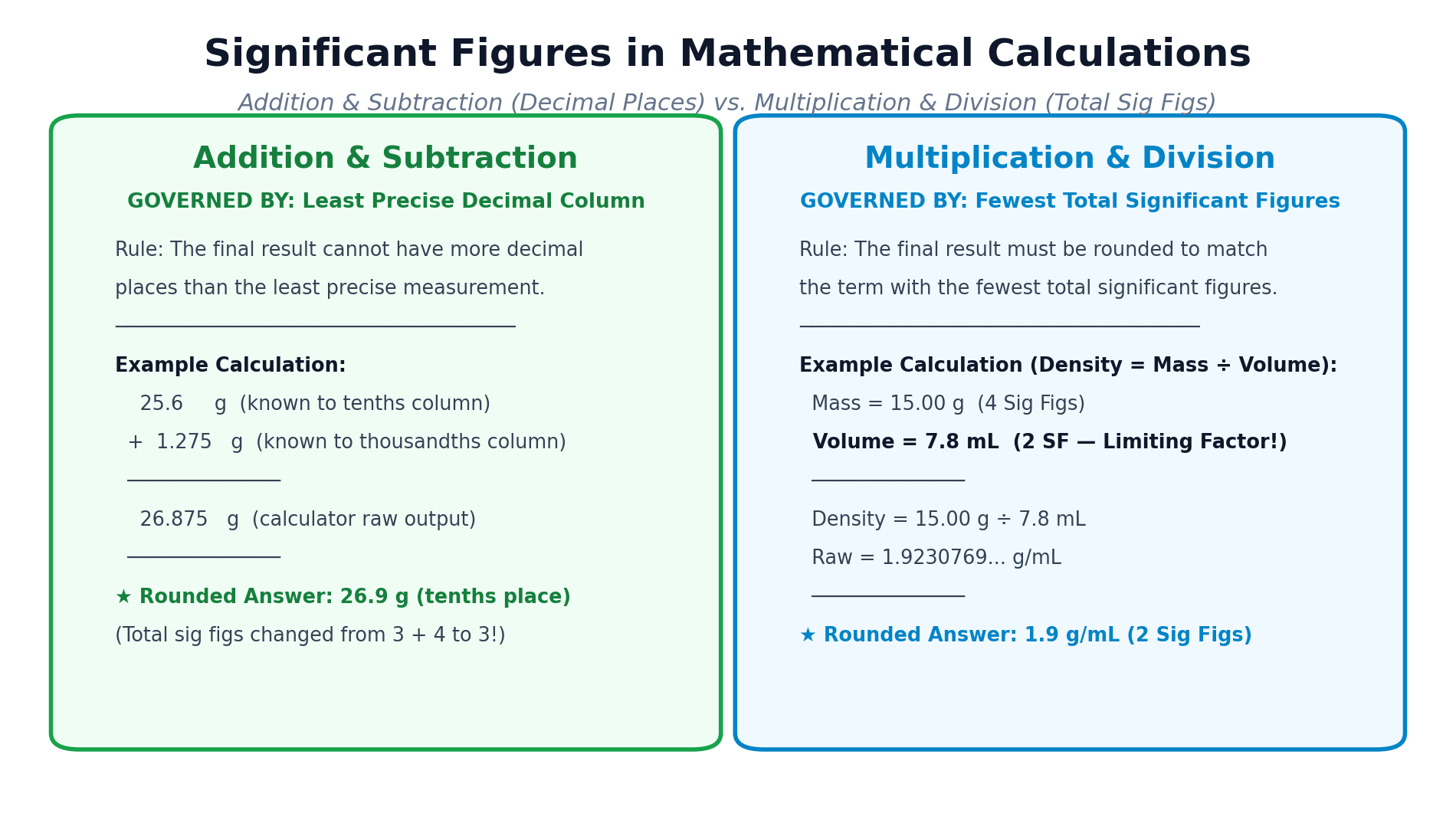
Notice that 118.1 mL has 4 total significant figures even though 12.4 mL had only 3! In addition/subtraction, place value rules supreme.
Suppose you measure an object's mass on a balance sensitive to tens of grams and record 1200 g. Does this number have 2, 3, or 4 significant figures? It is ambiguous! To eliminate ambiguity, chemists use Scientific Notation:
- To show 2 sig figs: write
1.2 × 10³ g - To show 3 sig figs: write
1.20 × 10³ g - To show 4 sig figs: write
1.200 × 10³ g(or1200. gwith a terminal decimal)
 Tyler DeWitt • 9:10
Significant Figures Made Easy!
Tyler DeWitt breaks down significant figure rules, leading and trailing zeros, and why rounding protocols protect experimental integrity (~9 min).
Practice Questions — Lesson 3
Formulate your answer to each question, then click "Show Solution & Explanation" to review the model solution and step-by-step reasoning.
- (a) 0.004050 g → 4 sig figs: Leading zeros are placeholders; 4 is significant; captive 0 is significant; trailing 0 is significant because decimal is present.
- (b) 50.00 mL → 4 sig figs: Non-zero 5 plus three trailing zeros with decimal present.
- (c) 1200 kg → 2 sig figs: Trailing zeros without decimal are ambiguous placeholders.
- (d) 1200. kg → 4 sig figs: The terminal decimal explicitly indicates precision to the ones place.
- (e) 3.080 × 10⁴ s → 4 sig figs: In scientific notation, all digits in the mantissa (3.080) are significant.
- (a) 0.0675: Leading zeros don't count. Digits 6, 7, 5 are kept; following digit (3) rounds down.
- (b) 4.60 × 10⁵ (or 460,000 with a bar over the 0): The 4, 5, and 9 are the first three digits. The following 6 rounds the 9 up to 10, carrying over to make 460,000. Scientific notation (4.60 × 10⁵) prevents ambiguous trailing zeros.
- (c) 12.05: Looking at hundredths place (4), following digit 9 rounds 4 up to 5.
Correct Rounded Answer: 24 g
Reasoning: This operation involves only multiplication and division. Therefore, the result is limited by the measurement with the fewest total significant figures:
- 15.20 g has 4 sig figs
- 4.02 g has 3 sig figs
- 2.5 g has 2 sig figs (limiting term!)
Rounding 24.4416 to 2 significant figures gives 24 g.
Raw addition: 25.6 + 1.245 + 0.03 = 26.875 g.
Correct Rounded Answer: 26.9 g
Reasoning: In addition and subtraction, the answer is governed by the fewest decimal places (least precise column). 25.6 g is known only to the tenths place (0.1 g). 1.245 g is known to thousandths, and 0.03 g is known to hundredths. The tenths place is the limiting column. Rounding 26.875 to the tenths place yields 26.9 g. Total significant figures do not govern addition!
Step 1 (Parentheses subtraction):
Step 2 (Division):
Notice how subtraction reduced the precision from 3 sig figs in the starting numbers to 2 sig figs in the difference, which then governed the final division quotient!
Lesson 4: Metric Conversions & Dimensional Analysis
In 1999, NASA lost the $125 million Mars Climate Orbiter when the spacecraft plunged into the Martian atmosphere and disintegrated. The accident investigation revealed that the navigation software developed by Lockheed Martin calculated thrust in English Imperial units (pound-force seconds), while NASA's guidance computers expected metric SI units (Newton-seconds). A simple failure of unit conversion destroyed years of scientific work. In chemistry, unit conversion is not an arbitrary arithmetic puzzle—it is a vital scientific discipline.
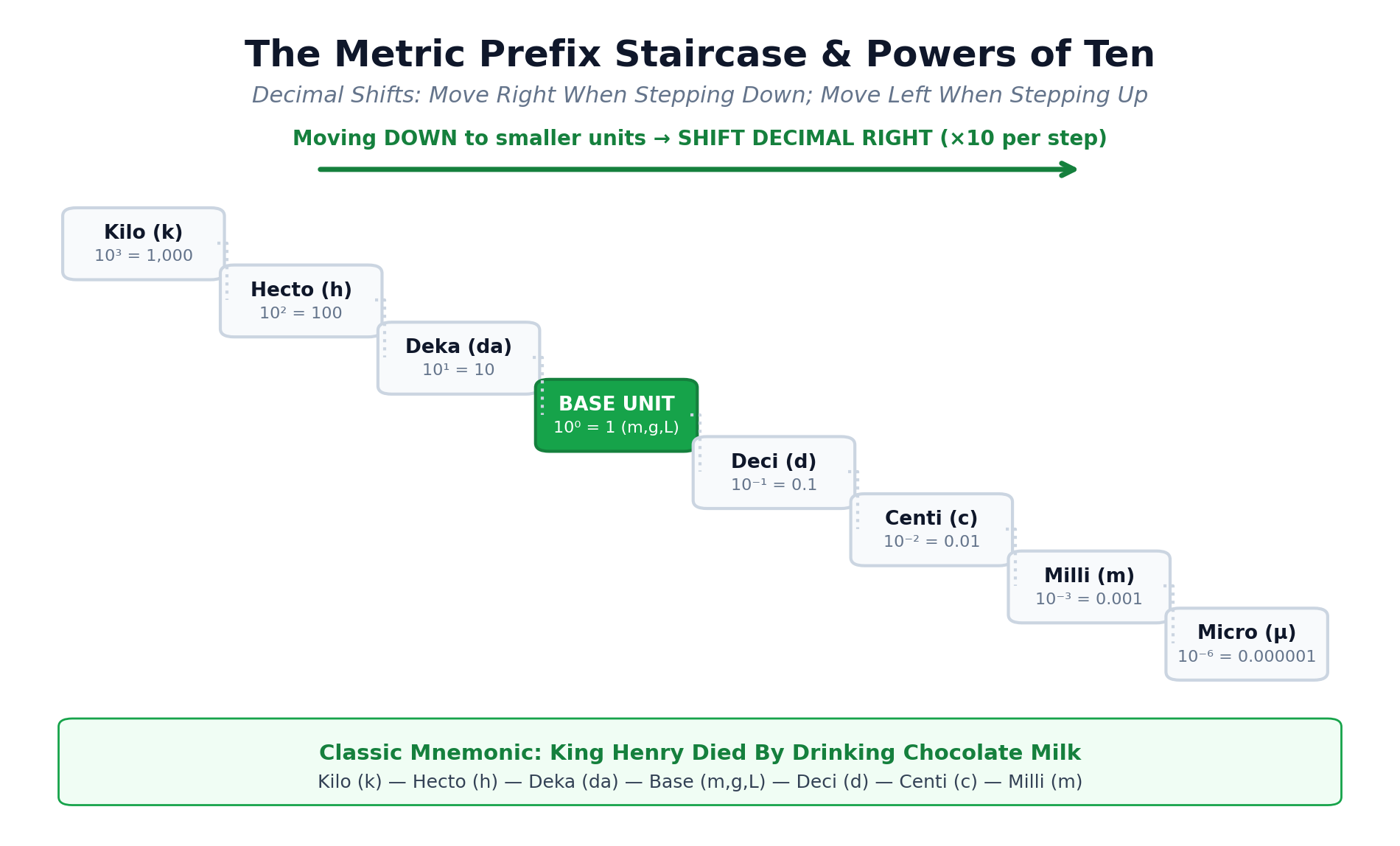
4.1 The Metric Prefix Ladder (Staircase)
The metric system uses prefixes to scale units by powers of ten. In Honors Chemistry, you must be fluent across the entire range from Giga (10<sup>9</sup>) down to Pico (10<sup>−12</sup>):
| Prefix Name | Symbol | Power of 10 Multiplier | Numeric Value | Concrete Chemical Example |
|---|---|---|---|---|
| Giga- | G |
10⁹ | 1,000,000,000 | Gigapascal (GPa) pressure inside Earth's mantle or diamond anvils. |
| Mega- | M |
10⁶ | 1,000,000 | Megajoule (MJ) energy released in commercial explosive reactions. |
| Kilo- | k |
10³ | 1,000 | Kilogram (kg), kilojoule (kJ) in thermochemical enthalpy changes. |
| Hecto- | h |
10² | 100 | Hectopascal (hPa) atmospheric pressure in meteorology. |
| Deka- | da |
10¹ | 10 | Dekaliter (daL) large volume storage containers. |
| [BASE UNIT] | m, g, L, s, mol |
10⁰ | 1 | Standard baseline quantity (1 meter, 1 gram, 1 liter, 1 second). |
| Deci- | d |
10⁻¹ | 0.1 | Deciliter (dL) in medical blood glucose testing (e.g. 90 mg/dL). |
| Centi- | c |
10⁻² | 0.01 | Centimeter (cm); 100 cm = 1 m. Laboratory glassware scale. |
| Milli- | m |
10⁻³ | 0.001 | Milligram (mg), milliliter (mL); 1000 mL = 1 L. Standard bench scale. |
| Micro- | μ (or u) |
10⁻⁶ | 0.000001 | Micrometer (μm), microgram (μg). Size of bacterial cells and aerosols. |
| Nano- | n |
10⁻⁹ | 0.000000001 | Nanometer (nm); visible light wavelengths (400–700 nm), atomic diameters. |
| Pico- | p |
10⁻¹² | 0.000000000001 | Picometer (pm); chemical bond lengths (C−C bond ≈ 154 pm). |
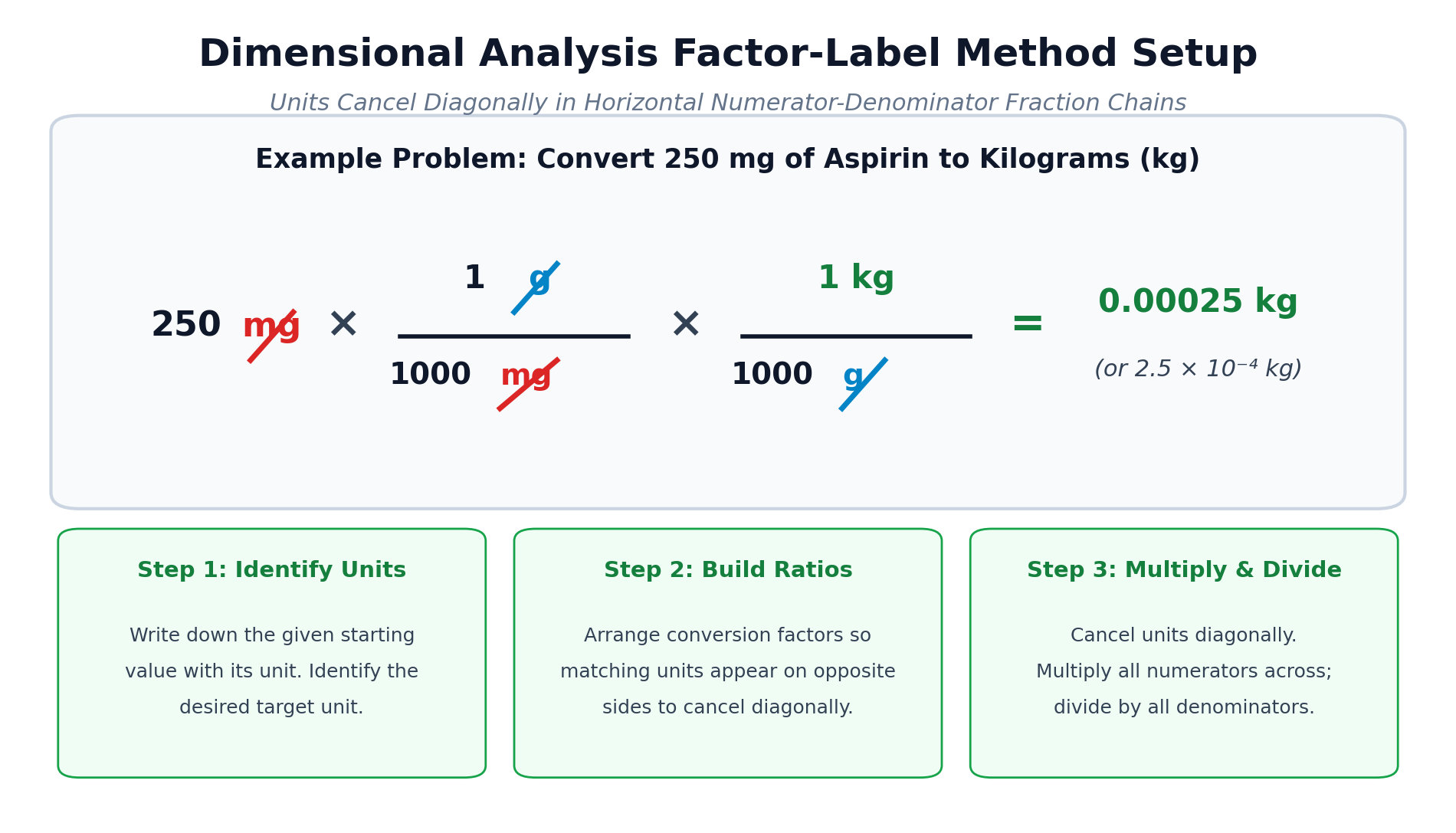
4.2 The Factor-Label Method: Multiplying by One
The Factor-Label Method (Dimensional Analysis) is based on a simple mathematical axiom: multiplying any quantity by 1 does not change its physical value, only its appearance. Because 1 kg = 1000 g, the fractions:
To convert units, we set up a conversion factor so that the unwanted starting unit is in the opposite position (numerator vs. denominator), allowing it to cancel diagonally across the fraction bar.
Worked Example: Converting Wavelength (450 nm → m)
A blue laser pointer emits light with a wavelength of 450 nm. Convert this wavelength to meters on 2 separate lines:
Nanometers cancel diagonally on 2 separate lines. Scientific notation properly expresses the significant figures.
Worked Example: Compound Unit Conversion (90.0 km/h → m/s)
To convert compound units, cancel the numerator unit and denominator unit in consecutive steps:
Kilometers cancel with kilometers in the first step; hours in the denominator cancel with hours in the numerator in the second step.
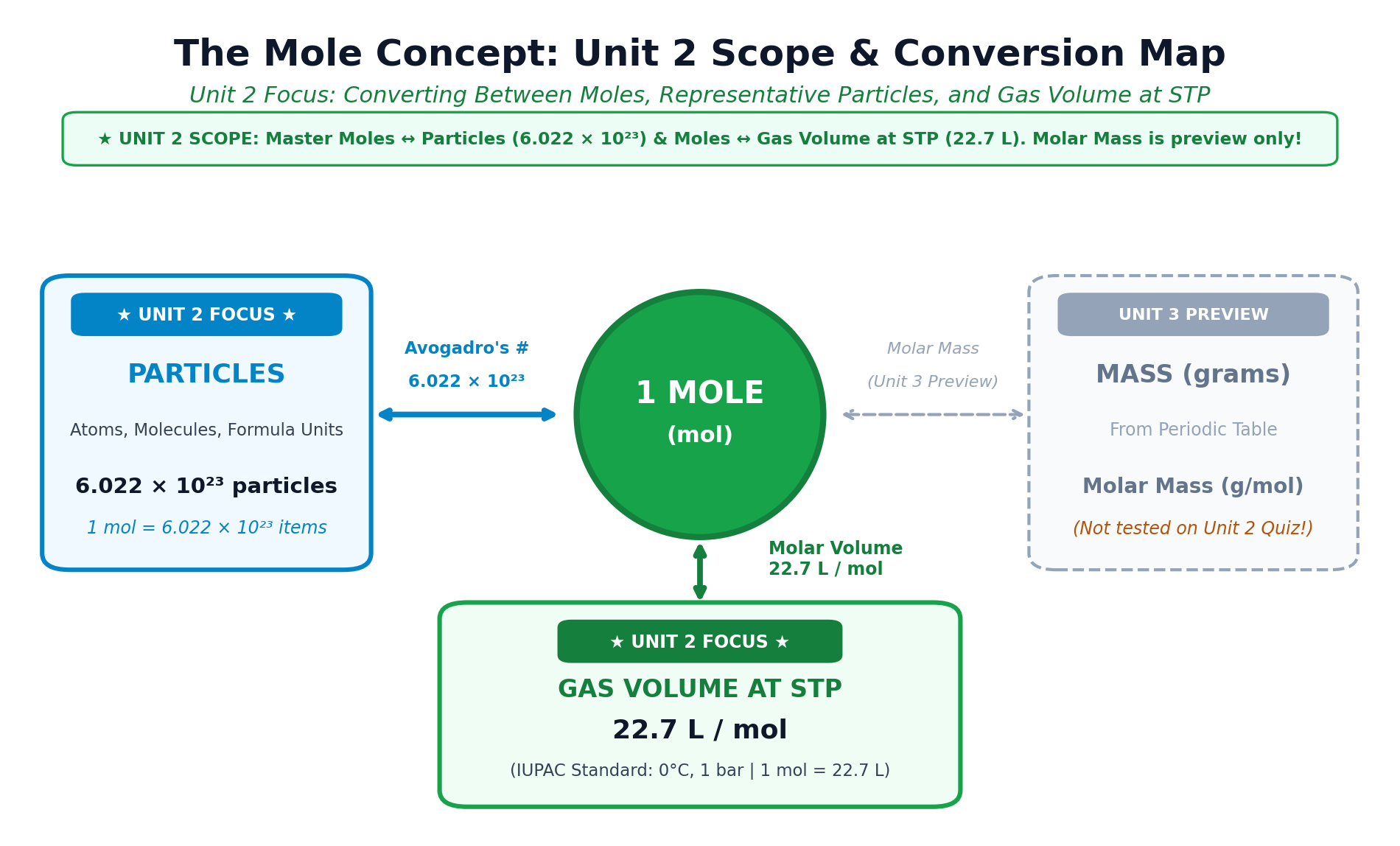
4.3 The Mole in Dimensional Analysis: The Chemist's Bridge
Individual atoms and molecules are far too small to count or weigh individually. A single carbon-12 atom has a mass of only 1.99 × 10⁻²³ grams! To bridge the gap between microscopic atoms and macroscopic laboratory scales, chemists use the Mole (mol), defined by Avogadro's constant:
Furthermore, at Standard Temperature and Pressure (STP: 0°C and 1 bar / 1 atm), exactly one mole of any ideal gas occupies a standard Molar Volume:
Worked Example: Moles to Molecules
A breath of exhaled air contains 2.7 moles of CO₂ gas. Calculate the total number of CO₂ molecules:
Moles cancel out diagonally on 2 separate lines, leaving discrete molecular count. Limited to 2 significant figures by 2.7 mol.
 Tyler DeWitt • 12:45
Converting Units with Conversion Factors
Tyler DeWitt walks through setting up 2-line factor-label fraction chains that cancel units diagonally (~12 min).
 Tyler DeWitt • 9:32
Converting Between Moles, Atoms, and Molecules
Tyler DeWitt demonstrates how Avogadro's number serves as the central conversion bridge in chemical calculations (~9 min).
Practice Questions — Lesson 4
Formulate your answer to each question, then click "Show Solution & Explanation" to review the model solution and 2-line calculations.
Use a two-step conversion chain: milligrams → grams → kilograms:
Milligrams cancel in step 1, grams cancel in step 2. Both conversion factors are exact.
Multiplying 589 by 10⁻⁹ gives 5.89 × 10⁻⁷ meters. Kept to 3 significant figures.
Moles of Cu cancel on separate lines, leaving total count of copper atoms. Rounded to 3 significant figures.
Liters cancel in the denominator on 2 separate lines, yielding moles of gas. Limited to 3 significant figures.
Grams cancel into kilograms, and cubic centimeters cancel into cubic meters across 2 separate lines. The factor is × 1000.
Lesson 5: Accuracy, Precision, Experimental Error & Quality Control
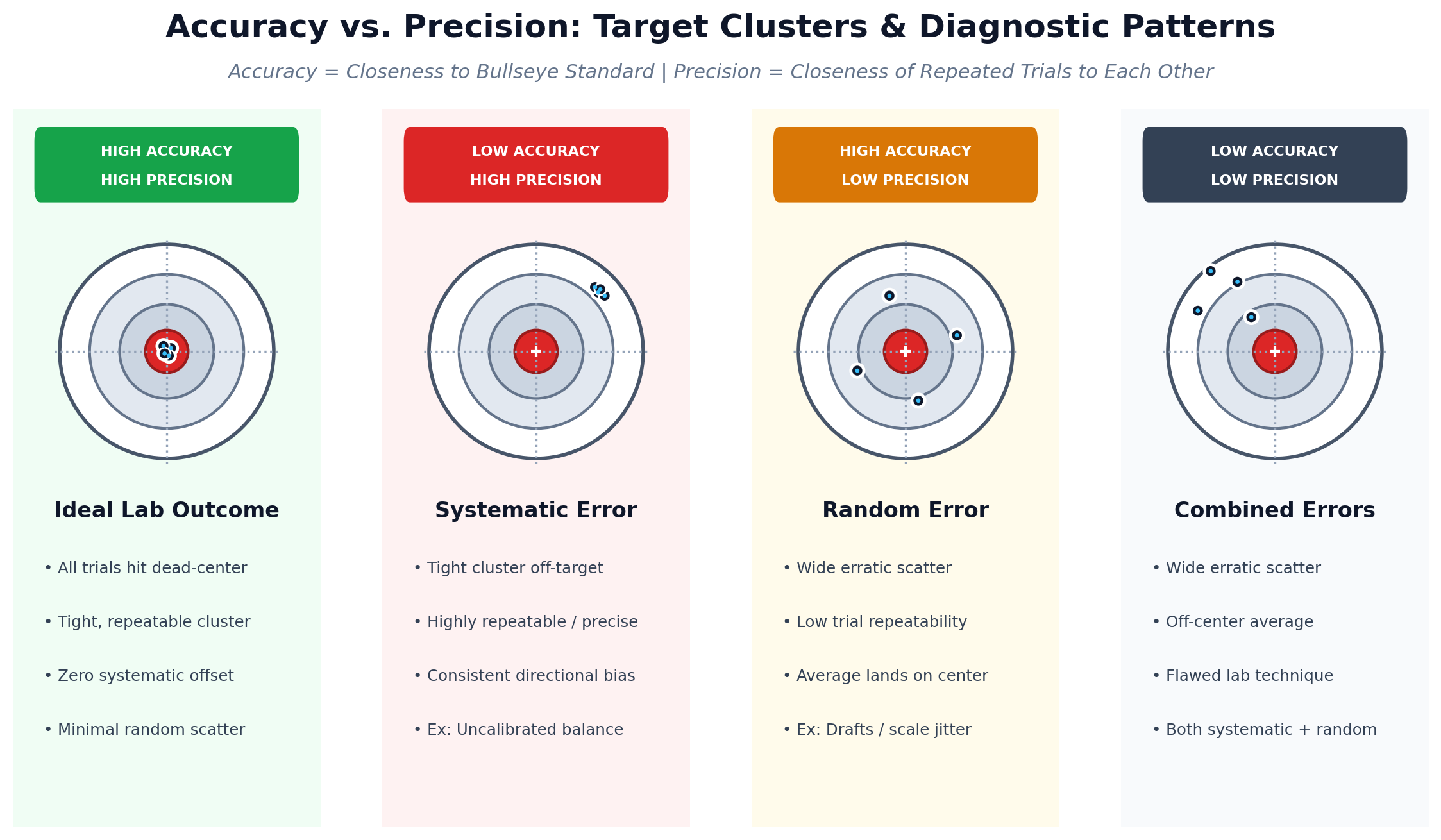
In everyday conversation, people frequently treat 'accurate' and 'precise' as interchangeable synonyms. If a student says, 'My watch keeps accurate time,' they usually also mean it is precise. In the physical sciences, however, Accuracy and Precision describe two completely independent aspects of measurement quality. An experimental dataset can be extremely precise while being catastrophically inaccurate!
5.1 The Crucial Difference Defined
| Concept | Scientific Definition | Target Dartboard Analogy | Diagnostic Lab Indicator |
|---|---|---|---|
| Accuracy | How close an experimental measurement or the mean of repeated measurements is to the true, accepted literature standard. | How close darts land to the center Bullseye. | Quantified by Percent Error: small percent error indicates high accuracy. |
| Precision | The reproducibility, repeatability, and consistency among independent measurements obtained under identical conditions. | How tightly clustered together the dart holes are to one another, regardless of where they land on the board. | Quantified by Range or Standard Deviation: small spread indicates high precision. |
5.2 Systematic Error vs. Random Error
Every deviation from perfection in a laboratory experiment stems from one of two fundamentally distinct error categories:
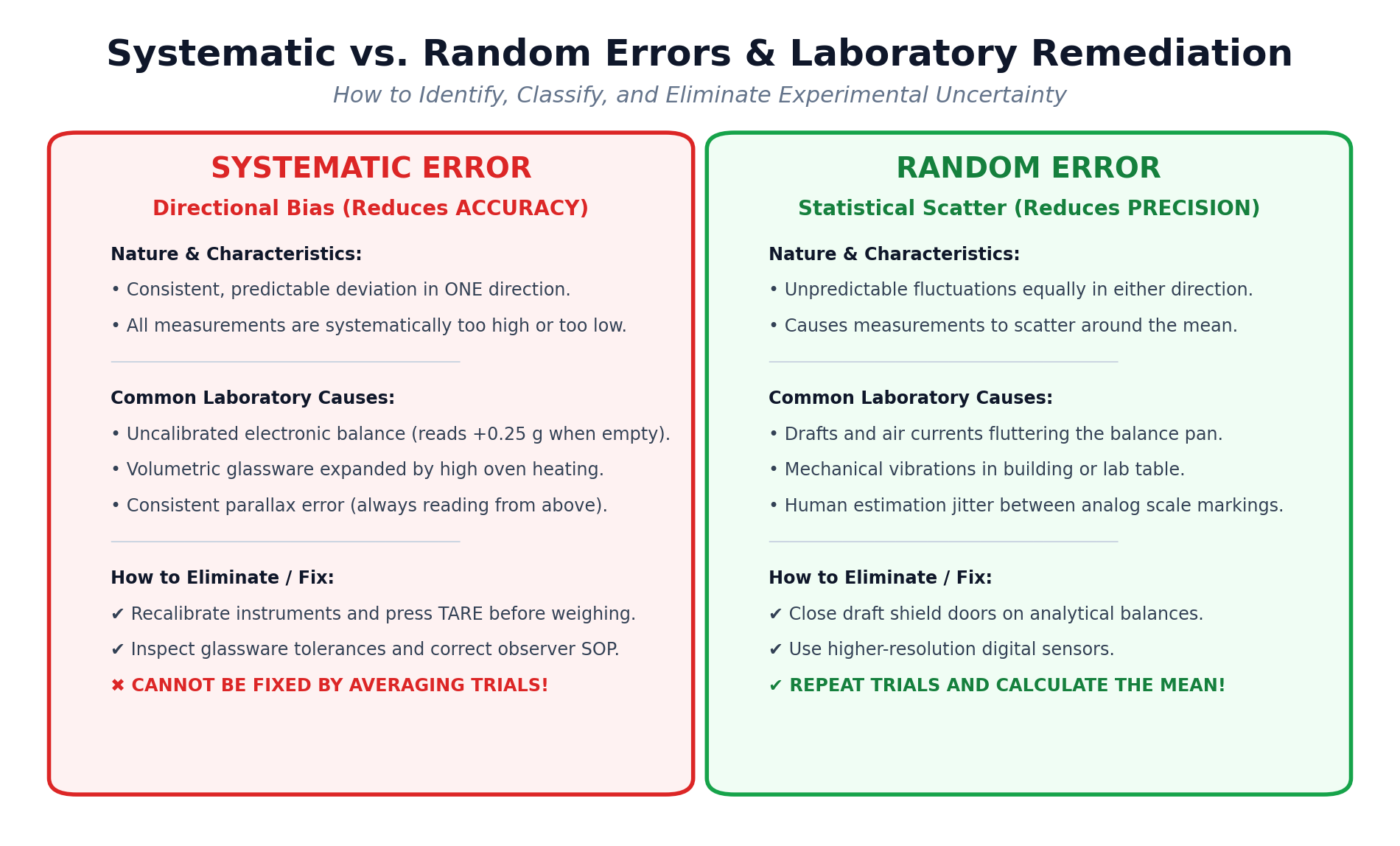
1. Systematic Errors (Flaws of Calibration or Technique)
A Systematic Error is a predictable flaw that biases every single measurement in the same direction—either consistently too high or consistently too low. Typical causes include:
- Calibration Offset: A digital electronic balance that reads 0.15 g when empty because someone forgot to press the TARE button. Every object weighed will be recorded 0.15 g too heavy.
- Thermal Expansion: Using volumetric glassware calibrated for 20°C to measure hot boiling liquid at 95°C. The expanded glass holds more liquid than marked.
- Persistent Parallax: An observer always reading a buret while looking down from above, systematically recording volumes too high.
- Improper Chemical Blank: A spectrophotometer zeroed with tap water instead of distilled solvent, absorbing extra light on every trial.
Systematic errors CANNOT be eliminated or reduced by repeating trials and calculating an average! If an uncalibrated scale reads +0.15 g too heavy, weighing a sample 100 times and calculating the average will still produce a result that is exactly +0.15 g too heavy. The only remedy is recalibration and correcting the physical procedure.
2. Random Errors (Statistical Environmental Noise)
A Random Error is an unpredictable, unavoidable statistical variation that scatters measurements symmetrically above and below the true value. Causes include:
- Air currents and drafts from overhead laboratory ventilation hoods fluttering the balance pan.
- Slight mechanical vibrations in the building or table surface.
- Minor electronic voltage fluctuations in digital sensors.
- Human visual estimation jitter when approximating the tenths digit between marks.
Random errors CAN be minimized by repeating trials and calculating the arithmetic mean (¯x). Because random fluctuations are equally likely to be positive or negative (+0.02 mL vs. −0.02 mL), summing multiple trials causes random deviations to cancel each other out, converging the sample mean directly onto the true value.
5.3 Quantitative Error Analysis: Percent Error Formula
To quantify how far an experimental result deviates from the true literature value, chemists calculate the Percent Error:
Notice: The absolute value bars in the numerator guarantee that percent error is always reported as a positive percentage.
Worked Example: Aluminum Density Percent Error
A student measures the density of aluminum via water displacement and records an experimental value of 2.64 g/cm³. The accepted literature density of pure aluminum is 2.70 g/cm³. Calculate the percent error:
5.4 Quality Control (QC) Standards in Industrial Chemistry
In pharmaceutical synthesis and chemical manufacturing, Quality Control (QC) teams inspect sample batches against strict percent error tolerances:
- Research & Analytical Grade: Error ≤ 1.0% to 2.0% (required for injectable medications and semiconductor reagents).
- Standard Laboratory Tolerance: Error ≤ 5.0% (typical student educational laboratory target).
- Batch Failure / Rejection: Error > 5.0% (requires immediate halt of the production line and formal investigation into systematic contamination or balance drift).
 Tyler DeWitt • 6:20
Accuracy and Precision
Tyler DeWitt explains dartboard target analogies, the difference between hitting the bullseye and grouping shots, and real laboratory data (~6 min).
 Tyler DeWitt • 10:15
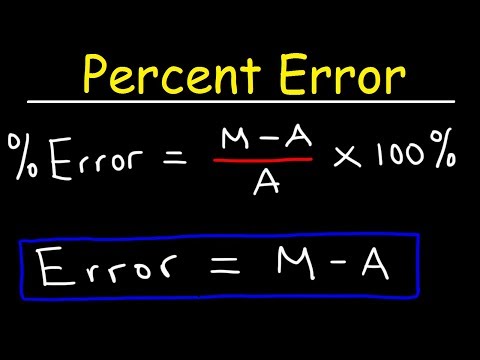
Error and Percent Error
Tyler DeWitt walks through setting up the percent error formula, absolute value in the numerator, and interpreting lab results (~10 min).
Practice Questions — Lesson 5
Formulate your answer to each question, then click "Show Solution & Explanation" to review the model solution and step-by-step reasoning.
Student A: High Precision, Low Accuracy. The three measurements (95.1, 95.2, 95.1) are extremely close to one another (range of only 0.1°C, showing outstanding reproducibility), but they are far from the true value of 100.0°C. This pattern is characteristic of a systematic error (such as an uncalibrated thermometer reading ~4.9°C too low).
Student B: High Accuracy, Low Precision. The individual measurements scatter widely (range of 3.7°C, indicating poor precision), but their arithmetic average (98.2 + 101.9 + 100.1) ÷ 3 = 100.07°C is extremely close to the true accepted value (high accuracy). This pattern reflects random error that averaged out.
(a) Systematic Error. The balance consistently biases every measurement by the exact same amount (+0.25 g) in one single direction.
(b) No, averaging will NOT reduce the error. Averaging reduces random errors because positive and negative fluctuations cancel. In contrast, every single trial on this balance contains an identical +0.25 g offset; thus, the average of 10 trials will still be exactly +0.25 g too heavy! The only solution is recalibrating the instrument or subtracting the 0.25 g zero-offset from each reading.
Apply the percent error formula:
The absolute difference (0.28 g) has 2 significant figures, so the final percentage is reported as 5.5% (or 5.49%).
(a) Random Error. Air drafts cause unpredictable fluctuations both above and below the true mass. Corrective Action: Close the balance draft shield glass doors, close nearby windows, and perform multiple trials to average out random air disturbances.
(b) Systematic Error. The thermally distorted pipet will deliver too much volume on every single trial. Corrective Action: Discard or recalibrate the damaged pipet; volumetric glassware must never be heated in high-temperature ovens because thermal expansion permanently destroys volumetric calibration.
Step 1: Calculate the mean concentration:
Step 2: Calculate Percent Error:
Step 3: Evaluate Range (Precision):
QC Decision: RELEASE THE BATCH.
- Percent Error (0.30%) is well below the 1.5% maximum tolerance limit (high accuracy).
- Data range (1.7 mg/mL) is within the allowable 2.0 mg/mL spread (high precision).
Searchable Key Vocabulary Glossary
Filter all 20 essential terms in real time by typing in the search box below:
Master Model Answer Key & Complete Step-by-Step Solutions
Comprehensive reference answers for all 25 practice questions across Lessons 1 through 5, complete with 2-line factor-label fraction chains, diagonal unit cancellations, and pedagogical explanations.
Lesson 1: The Metric System, SI Base Units & Derived Quantities
Cubic meters cancel diagonally on 2 separate lines. Limited to 3 significant figures.
Lesson 2: Reading Laboratory Instruments, The Meniscus & The Estimated Digit
Lesson 3: Significant Figures: Rules & Calculating
Lesson 4: Metric Prefix Conversions & Dimensional Analysis
Two-step factor-label chain with diagonal unit cancellations.
Nanometers cancel, leaving meters in scientific notation.
Avogadro's number converts macroscopic moles into discrete atoms.
Standard molar volume of 22.7 L/mol cancels liters, yielding moles.
Grams cancel to kg, and cm³ cancel to m³. Net multiplier is 1000.