Classification and Measurement of Matter
What matter is, how it behaves, and how we count it
🏆 Florida Next Generation Sunshine State Standards (NGSSS) Addressed
Lesson 1: Why Classify Matter?
Imagine you're standing in a grocery store aisle. On the shelf, you see a clear bottle of water, a cardboard cylinder of table salt, and a can of aerosol air freshener. In the freezer case, there's a tube of frozen orange juice concentrate. Each is an example of matter, but they are clearly different from one another. How do we begin to make sense of this variety? The first step is to organize, or classify, these substances based on their fundamental composition and properties.
As a scientist, classifying matter is more than just organizing a pantry. It allows us to understand the similarities and differences between substances, which in turn lets us predict how they will behave. By establishing a clear classification system, we can connect the things we observe on a macroscopic scale—like salt dissolving in water—to the unseen world of atoms and molecules. This framework is the foundation for understanding every chemical reaction you will study.
Pure Substances vs. Mixtures
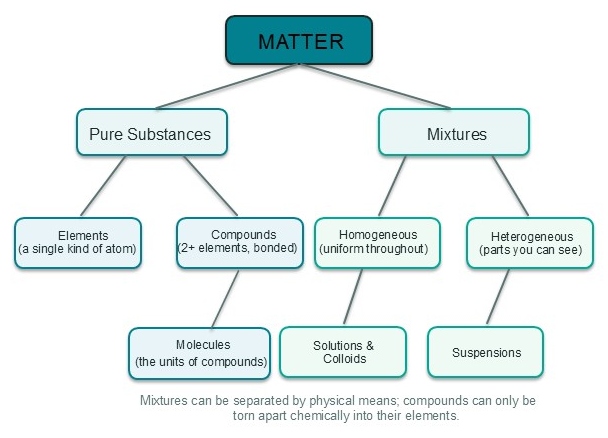
At the broadest level, all matter can be divided into two categories. A pure substance is matter that has a uniform and definite composition, meaning it's made of only one type of particle (atom or molecule). For example, pure water is always 11.2% hydrogen and 88.8% oxygen by mass, whether it's from an Antarctic glacier or a lab faucet. In contrast, a mixture is a physical blend of two or more pure substances in which each substance retains its own chemical identity. The composition of a mixture is variable; for instance, saltwater can be a little salty or very salty.
| Variable | Definite |
|---|---|
| Mixture | Pure Substance |
| Made of two or more substances that are physically mixed. | Made of only one type of substance (one type of atom or molecule). |
| Each substance keeps its original properties. | Has distinct properties different from its constituent elements. |
| Proportions of the substances can vary. | Proportions of the elements are fixed by mass. |
| Can be separated into its components by physical means (filtering, boiling, etc.). | Cannot be broken down into simpler substances by physical means. |
The two column labels above the table are the real point: the left column asks how variable the substance is, and the right column how definite. A mixture is the variable case because its composition can change from sample to sample, so it has no fixed set of characteristic properties—stir more or less sugar into your water and the density, the taste, and the boiling point all shift. A pure substance is the definite case because its composition is fixed, which gives it unchangeable, identifying properties: any sample of pure water boils at 100 °C and has a density of 1.00 g/mL under the same conditions, whether it comes from an Antarctic glacier or your kitchen tap. That is why measuring a single characteristic property like density can certify a pure substance, and why it can expose a mixture trying to pass itself off as one: mixtures never behave the same way twice, while pure substances always do.
The table also reveals the deep link between classification and change that will structure this entire unit. Because a
mixture is merely a physical blend, it can always be taken apart by a physical change—filter the sand out of salt water, boil the water away, or pick iron filings out of sand with a magnet—leaving every participating substance's identity untouched. A pure substance offers no such escape: physical changes only move its particles around (melting ice) and never break its identity, so the only way to pull a pure substance apart (say, to split a compound like water into hydrogen and oxygen) is a chemical change that actually rearranges atoms into new substances—and an element like gold cannot be broken into anything simpler by any means. In one line: mixtures are separated by physical changes; pure substances are altered only by chemical changes. As you read on, keep asking which side of the matter map each new substance belongs to—atoms, elements, molecules, and compounds will all turn out to live on the pure-substance side.
Asking the Right Questions: A Classification Decision Tree
 Professor Dave Explains • 3:50
Types of Matter: Elements, Compounds, and Mixtures
Professor Dave breaks down pure substances (elements and compounds) versus homogeneous and heterogeneous mixtures with clear molecular diagrams (~4 min).
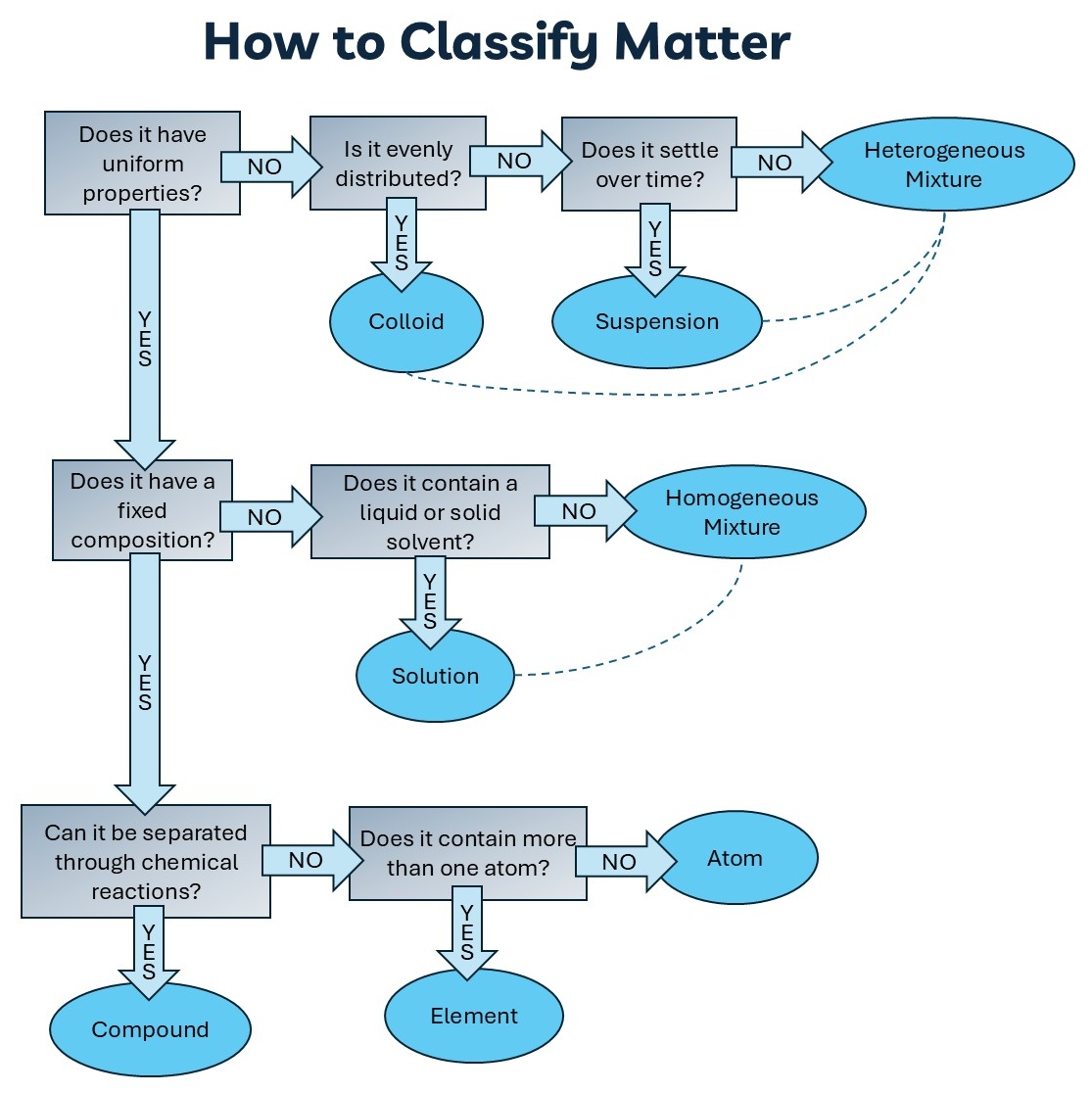
Figure 3.1 shows the answers, but a chemist works with questions. Here is the flow chart a scientist runs through with an unknown sample—each question is a test you can actually perform, and each answer drops the sample further down the tree until it lands in its smallest classification. You will learn the detailed tests behind every branch in the coming lessons; what matters now is seeing how one observation leads to the next.
Read the tree from the top. Q1 is the master question: uniform or not? A pure substance answers yes because it is one kind of particle all the way through, and the tree then asks whether a chemical change can break it apart—no means element, yes means compound. A mixture answers no, because mere physical blending can be patchy (trail mix) or even throughout (salt water); Q3 then separates homogeneous from heterogeneous, and Q4 and Q5 use particle size and the Tyndall effect to reach solution, colloid, or suspension. Memorize the shape of this tree now—every later chapter (atoms, elements, molecules, compounds) is just a closer look at one of its pure-substance branches, and mixtures-and-separation will zoom in on the other side.
Look at the ingredient list on any food package. A bag of 'Pure Cane Sugar' lists only one ingredient, sucrose, making it a pure substance. A box of cookie mix, however, is a mixture of flour, sugar, baking soda, and other components. Similarly, a municipal water quality report lists the concentrations of dissolved minerals and additives like chlorine and fluoride, confirming that your tap water is a mixture, not a pure substance.
Describing Matter: Physical and Chemical Properties
Once we classify something as a pure substance or a mixture, we can describe it further using its properties. A Physical Property is a quality or condition of a substance that can be observed or measured without changing the substance's composition. Think of color, hardness, melting point, and density—describing these doesn't turn the substance into something else. A Chemical Property, on the other hand, describes the ability of a substance to undergo chemical reactions and form new substances. To observe a chemical property, the substance must change its identity. Examples include flammability, toxicity, and reactivity with acid. Notice the pattern that will matter all unit long: a physical property shows up during a physical change that leaves the substance's identity untouched, while a chemical property is only ever revealed when a chemical change actually turns the substance into something new.
Worked Example: Calculating a Physical Property
Let's revisit a key physical property you mastered in Unit 2: density. A jeweler is trying to determine if a nugget of metal is pure gold. They measure its mass as 38.6 grams and, using water displacement, find its volume to be 2.00 cm³. To compare this to the known density of gold, they must first calculate the density of their sample.
The calculated density (19.3 g/cm3) perfectly matches pure gold, identifying the nugget via an intensive physical property.
The calculated density, 19.3 g/cm³, perfectly matches the accepted value for pure gold. Since density is a reliable and constant physical property for a pure substance, the jeweler can be confident their material is genuine. Notice that calculating the density didn't change the gold into something else; it merely described a characteristic it already had.
Worked Example: Identifying a Property
Scenario: A materials scientist is given a shiny, silvery metal cube. They first note its color and measure its density (physical properties). Then, they place a drop of concentrated acid on the surface and observe vigorous bubbling as the metal begins to dissolve. Is the metal's reaction with acid a physical or chemical property? * Student A says: "It's a physical property, because you can physically see the bubbles forming." * Student B says: "It has to be a chemical property, because the bubbling indicates a new gas is being produced and the metal is being consumed. The metal's ability to react with acid is what we're observing." * Student C says: "It's a physical property because no fire was involved, and chemical properties always involve burning." The habit to build is: Ask yourself, "Did the substance's fundamental identity change?" Student B is correct because the reaction created a new substance (a gas) and changed the metal itself. The potential to undergo that change is the chemical property.
Distinguishing between physical and chemical properties is critical for safety and engineering. You must know the flammability (a chemical property) of gasoline to design a safe fuel tank, but you use its density (a physical property) to calculate how much fuel weight an airplane can carry. Engineers select materials for a bridge based on physical properties like strength and flexibility, but they must also consider chemical properties like resistance to corrosion from rain and road salt.
This distinction between physical and chemical properties maps directly onto the physical changes and chemical changes you first met in Unit 1. A physical property describes what a substance can undergo without changing its identity, and reading the property lets you predict the change. Water's melting point (a physical property) predicts its melting (a physical change): solid ice becomes liquid water, but the H₂O molecules stay intact. A chemical property, by contrast, describes a substance's ability to turn into new substances, and it is revealed only through a chemical change. Iron's reactivity with oxygen (a chemical property) is what you actually watch happen when iron rusts
(a chemical change), producing a brand-new substance, iron(III) oxide. The two levels even line up with different forces: physical changes overcome the much weaker forces between molecules (intermolecular forces), while chemical changes break and form the strong bonds within molecules, crystal lattices, or atoms to rearrange them into new substances. Read any property and you can name the change it describes; watch any change and you can name the property that made it possible.
| Property type | Example property | The change it describes | Does identity change? |
|---|---|---|---|
| Physical | Melting point | Melting (solid → liquid) | No — water is still water |
| Physical | Boiling point | Boiling (liquid → gas) | No — water is still water |
| Physical | Density | Measuring mass and volume | No — nothing changes at all |
| Physical | Malleability | Hammering into a sheet | No — the metal stays the same metal |
| Physical | Solubility | Dissolving in water | No — particles mix, nothing changes |
| Physical | Electrical conductivity | Carrying a current | No — the wire is still copper |
| Chemical | Reactivity with acid | Bubbling and dissolving in acid | Yes — new substances form |
| Chemical | Flammability | Burning in oxygen | Yes — new substances form |
| Chemical | Reactivity with oxygen | Rusting | Yes — iron becomes iron(III) oxide |
| Chemical | Toxicity | Poisoning (reacting inside the body) | Yes — the substance reacts and changes |
Every property and change in the table is a classification tool in disguise. Take a physical test first: if you can measure a constant physical property and it matches the known value for a pure substance, you have good evidence the sample is genuinely that substance—the jeweler's density match proved the nugget was pure gold, and the acetone sample in today's practice problem shows the flip side, where a density deviation uncovers a mixture. Now push on the sample with a change: the key move is to watch whether the change rearranges identity. If a change is reversible and leaves the substance's composition intact (ice melts back to water, salt dissolves but can be recovered by boiling), the substance is only being moved, never broken, and the sample could be either a mixture or a pure substance—separation, not identity, is what is on the line. If a change is irreversible because new substances appear (sugar blackens and gives off gas in a heated pan; iron turns to rust), the identity of the reactants changes, which is exactly the signature of a chemical change. String these observations together and classification writes itself: a sample that can be pulled apart by a physical change with no new substances is a mixture, while a sample whose characteristic physical properties are constant and definite—and that only ever changes identity through chemistry—is a pure substance. In short, the properties you measure tell you what it is, and the changes it undergoes tell you what it can become; together they are the answers that the decision tree's questions are looking for.
Now that we can classify matter, describe it using its properties, and drive any unknown sample down the decision tree, we are ready to explore the specific branches. In the next lesson, we will follow the mixtures branch — the trail mix, salt water, and air all around us — and the physical techniques chemists use to take mixtures apart. After that,
the pure-substance branch (elements, atoms, molecules, and compounds) gets the same close-up treatment.
Practice Questions — Lesson 1
Formulate your answer to each question, then click "Show Solution & Explanation" to review the model solution, conceptual reasoning, and calculations.
(b) It is likely a mixture. The calculated density (0.786 g/mL) is close but different from the accepted value for pure acetone (0.7845 g/mL). Since density is a characteristic physical property of a pure substance, a deviation like this often indicates the presence of impurities, which would make the sample a mixture.
Lesson 2: Mixtures and How to Separate Them
Every morning, millions of people start their day by brewing coffee. Hot water pours over ground coffee beans held in a paper filter, and a dark, aromatic liquid drips into the pot below. The filter paper cleverly holds back the solid grounds while allowing the water and the flavorful compounds dissolved within it to pass through. This simple daily ritual is a perfect example of chemistry in action: you have just prepared a mixture and then used a physical process to separate its components. In this lesson, we will explore the world of mixtures and the techniques chemists use to take them apart.
Classifying Mixtures: A Tale of Two Types
In the last lesson, you learned to sort matter into the two great classes: pure substances and mixtures. But most matter you encounter, from the air you breathe to the salad dressing on your lunch, is not pure. These are examples of a Mixture, which is a physical blend of two or more substances that are not chemically combined. A key feature of a mixture is that each substance within it retains its own chemical identity and properties. The salt in salt water is still salt, and the water is still water; they are just intermingled.
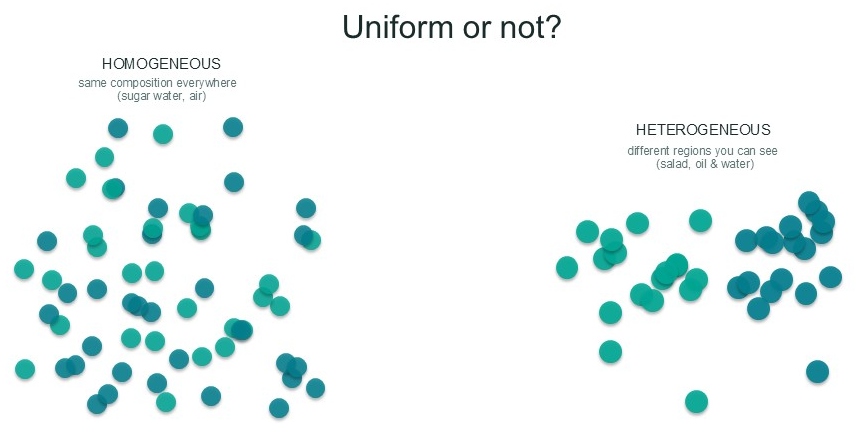
The first step in understanding a mixture is to look at its uniformity. If you can see distinct parts or regions with different properties, you have a Heterogeneous Mixture. The prefix 'hetero-' means 'different'. Think of a bowl of trail mix, where you can easily spot the individual peanuts, raisins, and chocolate pieces. Other examples include soil, granite, and a mixture of oil and water.
In contrast, if the mixture has a completely uniform composition and properties throughout, it is called a Homogeneous Mixture. The prefix 'homo-' means 'same'. Once you stir sugar into water, you can no longer see the individual sugar crystals; the sweetness is distributed evenly through the entire glass. Air (a mix of nitrogen, oxygen, and other gases), vinegar, and metal alloys like brass are all homogeneous mixtures.
| Non-uniform | Uniform |
|---|---|
| Heterogeneous Mixture | Homogeneous Mixture |
| Components are often visible and not uniformly distributed. | Components are not distinguishable and are uniformly distributed. |
| Contains two or more phases (e.g., solid and liquid). | Consists of a single phase (solid, liquid, or gas). |
| Properties vary from one part of the mixture to another. | Properties are consistent throughout the entire mixture. |
| Examples: Chicken noodle soup, sand and water, granite. | Examples: Salt water, clean air, vinegar, brass. |
Digging Deeper: Solutions, Colloids, and Suspensions
Homogeneous mixtures are often called solutions. A Solution is a specific type of homogeneous mixture where one substance, the Solute, is dissolved in another, the Solvent. The solute is the substance present in the smaller amount, while the solvent is present in the larger amount. In salt water, salt is the solute and water is the solvent. While
all solutions are homogeneous mixtures, not all homogeneous mixtures are solutions—this subtle distinction often relates to particle size and the specific roles of the components, but for our purposes, we can treat them very similarly.
Heterogeneous mixtures can also be sub-categorized based on particle size. A Suspension is a heterogeneous mixture containing large particles that will settle out over time due to gravity if left undisturbed. Muddy water is a classic example; after a while, the dirt and silt will sink to the bottom of the container. Orange juice with pulp is another suspension.
Between the tiny particles of a solution and the large ones of a suspension lies the Colloid. In a colloid, particles are intermediate in size and remain evenly dispersed without settling. Milk, fog, and mayonnaise are all colloids. They often appear cloudy or opaque, and you can identify them using the Tyndall Effect, which is the scattering of a beam of light by the dispersed particles. A true solution will not scatter light, but shining a flashlight through a colloid will reveal the beam's path.
Understanding how to separate mixtures is a matter of life and death. More than 2 billion people lack access to safely managed drinking water. Many live in coastal areas where the only abundant water is saltwater—a solution of salts dissolved in water. The process of desalination uses separation techniques like distillation or reverse osmosis to remove the salt solute from the water solvent, turning undrinkable seawater into fresh water for drinking, farming, and industry.
The Art of Separation: Exploiting Physical Differences
 FuseSchool - Global Education • 4:15
How To Separate Solutions, Mixtures & Emulsions
Live laboratory demonstrations of filtration, evaporation, chromatography, and distillation (~4 min).
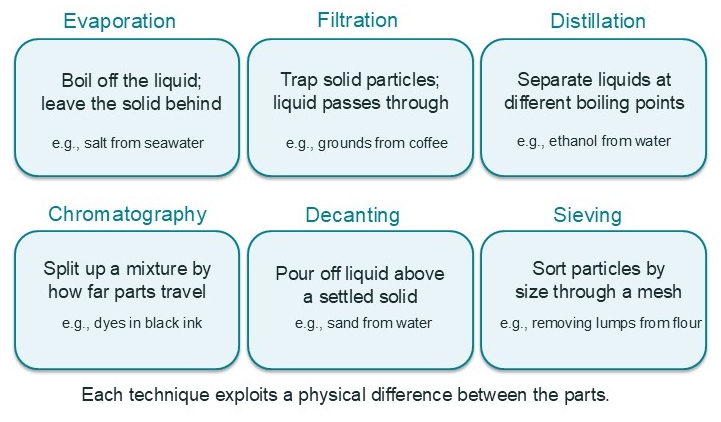
Since the components of a mixture are not chemically bonded, we can separate them using physical changes that exploit their different physical properties — the same property-to-change link you met in Lesson 1. Each separation technique is a physical change: the substances keep their identity and are simply pulled apart. If one substance is a solid and the other a liquid, we can use a filter. If two liquids have different boiling points, we can separate them by heating. The trick is to choose the right tool for the job based on the physical characteristics of the substances you want to separate. Remember what makes this possible: mixtures are only physically blended, so they are always separable by physical changes — while a pure substance, held together by chemical bonds or a single particle type, never comes apart this way and changes only through a chemical change.
| Technique | Property Exploited | Example |
|---|---|---|
| Filtration | Difference in particle size (separates an insoluble solid from a liquid) | Using a coffee filter to separate coffee grounds from brewed coffee. |
| Evaporation | Difference in boiling point (recovers a soluble solid from a liquid) | Heating salt water to boil off the water and leave the salt behind. |
| Distillation | Difference in boiling points (separates two or more liquids, or a liquid from a soluble solid) | Separating ethanol from water; purifying water. |
| Chromatography | Difference in attraction to a stationary phase vs. a mobile phase | Separating the different colored pigments in black ink. |
| Decanting | Difference in density (carefully pouring off a liquid from a settled solid) | Pouring water off of sand that has settled to the bottom. |
| Sieving | Difference in particle size (separating solids of different sizes) | Using a sieve to separate pebbles from sand. |
One of the most powerful separation techniques is Chromatography. This method separates substances based on how they move through a special material. In all chromatography, there is a Stationary Phase (the material that stays put, like paper or a packed column) and a Mobile Phase (a liquid or gas that moves through the stationary phase). Components that are more attracted to the stationary phase move slower, while components that are more soluble in the mobile phase move faster, resulting in separation.
Pharmaceutical companies rely heavily on high-performance liquid chromatography (HPLC) to produce life-saving medicines. After a drug is synthesized, the reaction mixture often contains the desired drug along with unreacted starting materials and unwanted byproducts. HPLC is used to separate the pure drug compound from these impurities, ensuring the final product is safe and effective. It's a critical step in quality control for virtually every pill you see at the pharmacy.
Understanding how to classify and separate mixtures is a fundamental skill for a chemist. These physical separations allow us to isolate, purify, and analyze substances without changing their chemical nature. But this raises a natural question: what sits inside those pure substances, elements and compounds, that we can separate out so cleanly? That is the world of matter's smallest building blocks, which we will meet in the next lesson.
Practice Questions — Lesson 2
Formulate your answer to each question, then click "Show Solution & Explanation" to review the model solution, conceptual reasoning, and calculations.
Convert sample volume to liters:
Next, calculate dissolved salt mass from salinity (35.0 g/L):
Lesson 3: Atoms — The Building Blocks of Matter
Consider the brilliant, nearly indestructible diamond on a ring and the soft, grey pencil lead used for writing. It may be surprising to learn they are both made of the exact same stuff: pure carbon. How can one substance be the hardest material known while the other is soft enough to leave a mark on paper? The answer lies not in what they are made of, but how their fundamental particles are arranged, a journey that begins deep inside a single carbon atom.
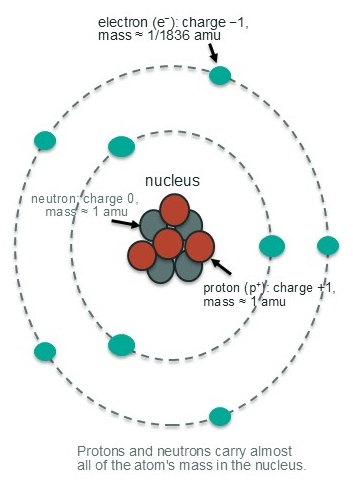
This fundamental particle is called an atom, which is the smallest unit of an element that retains all of the chemical properties of that element. If you could somehow break a piece of pure gold down to its smallest possible piece, that single atom would still behave like gold. This connects directly to the matter map you built in Lesson 1: gold is a pure substance, and the atom is the identity-carrying particle that makes it one. When every atom in a sample is identical—all gold, or all carbon, or all silicon—the sample is an element, and elements, you may recall, live on the pure-substance side of the classification. So the story of this lesson is really the story of the other half of that map: what the particles inside a pure substance actually look like. We now know that atoms themselves are composed of even smaller components called subatomic particles. The three most important for chemistry are the positively charged proton (p+), the neutral neutron (n⁰), and the negatively charged electron (e⁻).
Diving Inside the Atom
 Tyler DeWitt • 10:14
Basic Atomic Structure: A Look Inside the Atom
Tyler DeWitt explains how to find protons, neutrons, and electrons using atomic number Z and mass number A (~10 min).
At the center of every atom is a tiny, incredibly dense region called the nucleus. This core contains all of the atom's protons and neutrons packed tightly together. The much lighter electrons can be visualized as occupying distinct energy levels or shells that surround this central nucleus, held in place by their attraction to the positive protons.
| Particle | Symbol | Mass (g) | Mass (amu) | Charge (C) | Relative Charge |
|---|---|---|---|---|---|
| Proton | p⁺ | 1.673 x 10⁻²⁴ | 1.007 | +1.602 x 10⁻¹⁹ | +1 |
| Neutron | n⁰ | 1.675 x 10⁻²⁴ | 1.009 | 0 | 0 |
| Electron | e⁻ | 9.109 x 10⁻²⁸ | 0.0005 | -1.602 x 10⁻¹⁹ | -1 |
An Atom's Identity Card
The single most important feature of an atom is its proton count. The atomic number (often abbreviated as Z) is the number of protons in an atom's nucleus. This number uniquely identifies an element; for example, any atom with 6 protons is carbon. While protons define an element, the mass number (A) is the total count of protons and neutrons in the nucleus. It gives us a good approximation of the atom's total mass, since electrons are so light their mass is considered negligible in this context.
Gold's unique atomic structure, with 79 protons creating a strong pull on its inner electrons, makes it an excellent electrical conductor that also resists corrosion. This is why a thin layer of gold is used to plate critical electrical contacts in high-end electronics like smartphones and satellites, ensuring a reliable connection for years.
Simplifying the Subatomic: Relative Mass and Charge
If you look at the table above, you'll notice that the actual masses in grams and charges in Coulombs are extremely small. To simplify calculations, chemists use a relative scale. For mass, the International Union of Pure and Applied Chemistry (IUPAC) defined the atomic mass unit (amu) as 1/12th the mass of a carbon-12 atom. On this scale, the mass of a proton or neutron is conveniently about 1 amu. A similar system is used for charge, where we define the charge of one proton as +1 and one electron as -1, which makes it easy to see that neutral atoms have a total charge of zero.
Worked Example: Converting an Atom's Mass to amu
From Unit 2, you know how to convert between units using dimensional analysis. Let's apply that skill. Given that the precise mass of a single sulfur atom is 5.307 x 10⁻²³ g, we can
convert this to the more convenient amu scale using the conversion factor 1 amu = 1.66054 x 10⁻²⁴ g.
Grams cancel diagonally on 2 separate lines, converting directly into atomic mass units.
How Structure Determines Properties
The properties of an element—its reactivity, its state of matter, its conductivity—are all determined by its atomic structure. The two most important factors are the nuclear charge (the number of protons) and the arrangement of its electrons. A stronger nuclear charge pulls electrons in more tightly, while the number of electrons in the outermost shell dictates how an atom will interact and bond with other atoms, as shown in the figure below.
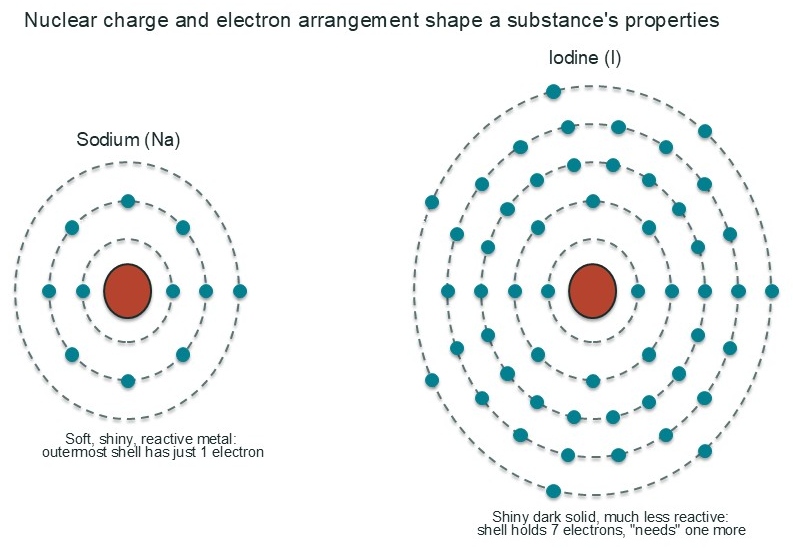
Ultimately, chemistry is the study of electrostatic forces. The attraction between the positive nucleus and negative electrons holds atoms together. The repulsion between electrons on neighboring atoms keeps them from collapsing into each other. Understanding these fundamental forces is the key to understanding why chemical reactions happen, why certain materials are strong and others are brittle, and how life itself is possible.
Now that we have established the basic components of an individual atom, we can begin to explore how these building blocks combine. The forces that hold atoms together create the molecules and compounds that make up our world, a topic we will dive into next.
Practice Questions — Lesson 3
Formulate your answer to each question, then click "Show Solution & Explanation" to review the model solution, conceptual reasoning, and calculations.
The calculation requires a three-step factor-label conversion: grams of Si → moles of Si → atoms of Si → total protons:
Grams, moles, and individual atoms cancel diagonally on 2 separate lines, yielding total nuclear protons.
Lesson 4: Elements, States of Matter, and the Periodic Table
Imagine placing a solid ice cube into a pan of warm water. The cube shrinks, disappearing into the liquid. If you then heat the pan on a stove, the water level drops as billowing steam—a gas—fills the air. In every stage, the substance is still water, yet its properties are dramatically different. This everyday observation highlights a central question in chemistry: What are substances made of, and how do the arrangements of their fundamental particles determine the properties we can see, touch, and measure?
The Simplest Substances: Elements
At the most basic level, all matter you've ever encountered is composed of one or more fundamental substances. An element is a pure substance consisting of only one type of atom, which cannot be broken down into a simpler substance by chemical means. Recall the matter map from Lesson 1: this is the definition of the 'strong' side of classification. An element is a pure substance because its composition is definite and unvarying—every atom of every sample is the same kind of atom—and it sits on the branch of the map reserved for pure substances, never on the mixture branch. Every element is given a unique one- or two-letter symbol, like H for hydrogen or Fe for iron (from its Latin name, ferrum). Pay close attention to capitalization: Co is the symbol for the element cobalt, a metal, while CO represents carbon monoxide, a compound made of two different elements.
Not All Atoms of an Element Are Identical
While all atoms of an element have the same number of protons, they don't always have the same mass. This is because of isotopes, which are atoms of the same element that have the same number of protons but different numbers of neutrons. For example, every carbon atom has 6 protons, but some have 6 neutrons (carbon-12) while others have 8 (carbon-14). Because of the natural existence of different isotopes, the mass on the periodic table is not a whole number. Instead, it is the average atomic mass, a weighted average that accounts for the abundance of each isotope in nature.
Worked Example: Writing Isotope Symbols
Scenario: A scientist is analyzing a sample of uranium for a nuclear reactor and needs to distinguish between two isotopes: one with a mass number of 235 and another with a mass number of 238. How should she note this in her lab book?
Student A writes U-235 and U-238. Student B writes ²³⁵U and ²³⁸U. Student C writes ²³⁵₉₂U and ²³⁸₉₂U. All three notations are technically correct ways to communicate the specific isotope. Notation C is the most complete, showing the mass number (top) and atomic number (bottom), but notation B is the most common shorthand in chemistry. The habit to build is using the mass number as a superscript to the left of the element's symbol to clearly and concisely identify a specific isotope.
The Four States of Matter
 FuseSchool - Global Education • 4:22
States Of Matter - Solids, Liquids & Gases
Kinetic molecular theory breakdown of particle arrangements, kinetic energy, and phase changes (~4 min).
Depending on temperature and pressure, elements and compounds can exist in different physical forms. A solid has a definite shape and volume because its particles are tightly packed in a fixed structure. A liquid has a definite volume but takes the shape of its container, as its particles can slide past one another. A gas has neither a definite shape nor volume, expanding to fill whatever container it occupies because its particles are far apart and move randomly. The fourth state, plasma, is a high-energy state similar to a gas but where atoms have been stripped of their electrons; it's the most abundant state of matter in the universe, found in stars and lightning.
On a cold winter day, you can see your breath. The warm, moist air from your lungs (a gas) cools rapidly when it hits the cold outside air. This causes the water vapor to undergo condensation, changing directly into tiny liquid water droplets or ice crystals that you see as a small cloud.
Why States of Matter Exist: Kinetic Molecular Theory
The Kinetic Molecular Theory (KMT) explains that the state of a substance depends on the competition between two factors: the kinetic energy of its particles (their energy of motion) and the strength of the forces between those particles. When kinetic energy is low, intermolecular forces dominate, holding particles in the fixed, rigid structure of a solid. As energy is added (e.g., by heating), particles move faster, overcoming these forces to enter the liquid and then the gas state.
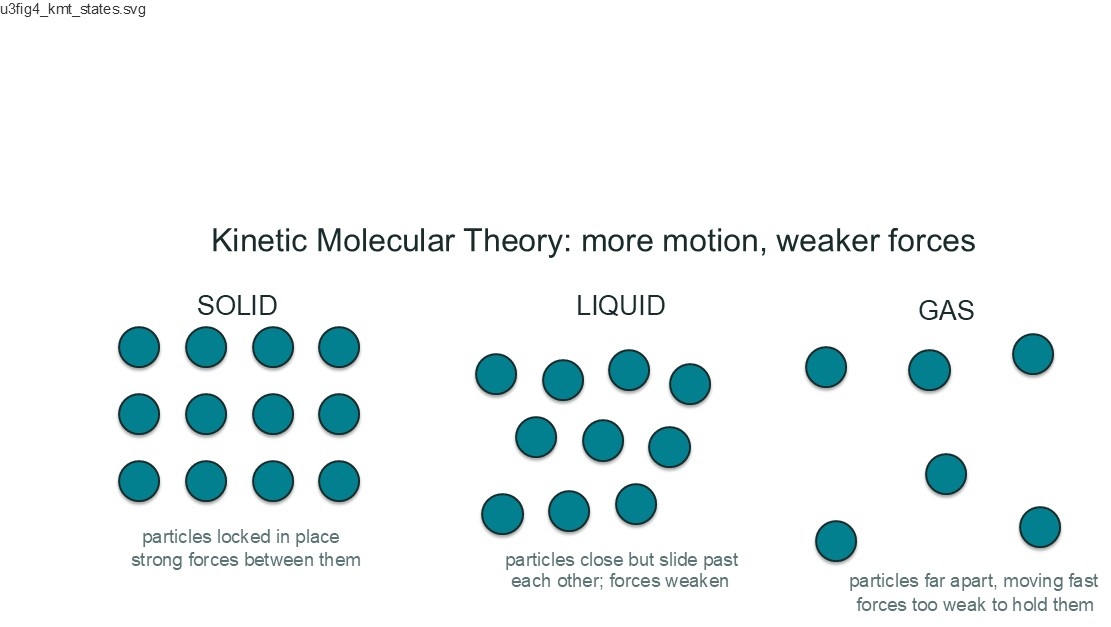
Every state transition is a physical change — the substance changes form but not its identity — and these transitions also involve energy changes. Processes that absorb energy include melting (solid to liquid), evaporation (liquid to gas), and sublimation (solid directly to gas). The reverse processes release energy: freezing (liquid to solid), condensation (gas to liquid), and deposition (gas directly to solid). The transition from liquid to gas at a liquid's surface is evaporation; when this process happens rapidly throughout the bulk of the liquid, we call it boiling.
Notice what this says about the classification you built in Lesson 1. A pure substance definitely has physical properties — melting point, boiling point, density — and it absolutely undergoes physical changes like melting and freezing. But here is the key point: those physical changes never separate a pure substance into different components. When pure water freezes or boils, it is still only water; one component in, one component out. Because a pure substance is a single type of atom or molecule, there is nothing inside it to separate — physical changes only rearrange the identical particles, not pull different ones apart. Only a chemical change (or no change at all, for an element) can take a pure substance apart. This is exactly the opposite of a mixture, which is physically separable by definition. Hold on to this contrast as we continue: elements — and later, compounds — are pure substances, and every physical property or change you meet from here on will apply to them without ever splitting them into simpler substances.
A Tour of the Periodic Table: Metals, Nonmetals, and Metalloids
The periodic table isn't just a list; it's a map that organizes elements by their properties. The broadest classification divides elements into three groups. Metals, which dominate the left side and center of the table, are typically shiny, good conductors of heat and electricity, and solid at room temperature. They are often malleable (can be hammered into sheets) and ductile (can be drawn into wires). Nonmetals, on the upper right, are generally poor conductors, are brittle if solid, and can be solids, liquids, or gases at room temperature. In between is a small group of metalloids that have intermediate properties, making them useful as semiconductors in electronics.
| Property | Metals | Nonmetals | Metalloids |
|---|---|---|---|
| Conductivity | High thermal and electrical | Low thermal and electrical (insulators) | Intermediate (semiconductors) |
| Appearance | Shiny, lustrous | Dull | Can be shiny or dull |
| Malleability/Ductility | Malleable and ductile | Brittle (if solid) | Brittle |
| State at 25°C | Solid (except Hg) | Solid, liquid, or gas | Solid |
| Examples | Iron (Fe), Copper (Cu), Gold (Au) | Oxygen (O), Carbon (C), Sulfur (S) | Silicon (Si), Germanium (Ge) |
The properties of metals, nonmetals, and metalloids directly determine their use. The high ductility of copper makes it perfect for electrical wiring. The low conductivity of nonmetals like sulfur and phosphorus makes them key ingredients in matches. The unique semiconductor properties of the metalloid silicon are the foundation of every computer chip and smartphone processor.
Charged Atoms: Ions
Atoms are neutral when they have an equal number of protons and electrons. Yet most atoms do not stay neutral for long: they gain or lose electrons to become more stable, forming an ion — an atom (or group of atoms) with a net electrical charge. The drive behind it is the same for every element: the pull toward a full outer energy level, the stable noble-gas configuration you will meet again in Unit 4. What decides how an atom gets there is how strongly its nucleus controls electrons, and that strength comes straight from where the element sits on the periodic table. A metal on the left side has only a few outer electrons that sit far from a relatively small number of protons and are shielded by inner shells — so it holds its outermost electrons weakly and finds it far easier to lose one or two than to pull in many. Losing electrons leaves it with more protons than electrons, so it becomes a positively charged ion called a cation, such as Na⁺. A nonmetal on the right side, by contrast, is a small atom whose nucleus pulls strongly on the few outer electrons that sit close to it, and it eagerly pulls in one or two more to complete its outer shell. Gaining electrons gives it more electrons than protons, so it becomes a negatively charged ion called an anion, such as Cl⁻.
| Hold Electrons Weakly | Hold Electrons Strongly |
|---|---|
| Cations are formed when neutral atoms lose electrons. | Anions are formed when neutral atoms gain electrons. |
| Typically formed by metals. | Typically formed by nonmetals. |
| Have a positive charge (e.g., Na⁺, Ca²⁺, Al³⁺). | Have a negative charge (e.g., Cl⁻, O²⁻, N³⁻). |
| Form from atoms that hold their outer electrons WEAKLY — few valence electrons, shielded from a small nucleus. | Form from atoms that hold and attract electrons STRONGLY — small atoms whose nuclei pull hard on their electrons. |
| Easier to lose electrons than to gain many: losing one or two reaches a full outer shell. | Easier to gain electrons than to lose several: gaining one, two, or three completes the outer shell. |
Elements That Stick Together: The Diatomics
Some elements are rarely, if ever, found in nature as single, isolated atoms. Seven of the nonmetals are so reactive that they pair up with another atom of their own kind to form a two-atom molecule. A diatomic element is an element that exists naturally as a molecule containing two atoms. Forgetting this crucial detail is a common mistake when working with these elements in chemical reactions. The seven diatomic elements are hydrogen, nitrogen, oxygen, fluorine, chlorine, bromine, and iodine.
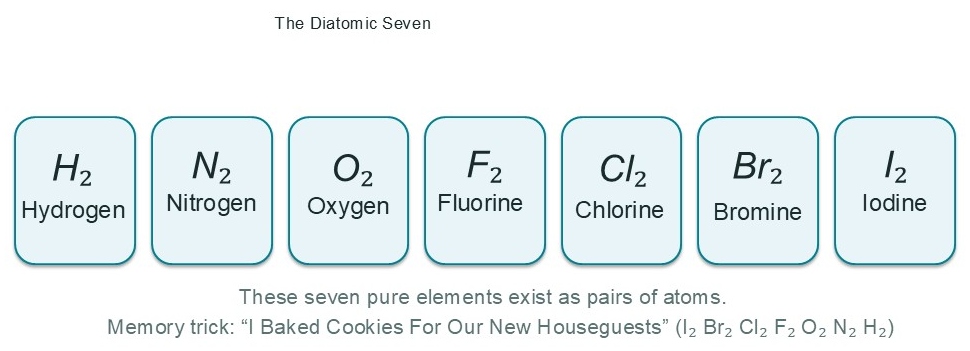
Now that we have surveyed the properties of the elemental building blocks, we are ready to see how they combine in fixed ratios to form the millions of different compounds that make up our world. Remember that elements and the compounds they form are the two branches of the pure-substance side of the matter map you built in Lesson 1 — fixed in composition, fixed in properties, and separable only by chemical means.
Practice Questions — Lesson 4
Formulate your answer to each question, then click "Show Solution & Explanation" to review the model solution, conceptual reasoning, and calculations.
Oxygen is one of the seven diatomic elements (BrINClHOF), so its formula is O<sub>2</sub> with a molar mass of 2 × 16.00 = 32.00 g/mol:
Grams cancel diagonally on 2 separate lines. Limited to three significant figures.
Lesson 5: Molecules and Compounds
If you've ever mixed baking soda and vinegar to make a model volcano, you've witnessed chemistry in action. The two distinct substances, a white powder and a clear liquid, react to create something entirely new: a fizzing gas. This transformation is not a simple mixing, like making trail mix; the original substances are consumed to form a new one. This happens because atoms, the fundamental building blocks you learned about, can link together in new ways. Understanding how atoms bond together is the key to understanding how a familiar substance like water is formed and why table salt behaves so differently from table sugar.
Molecules: Atoms in Groups
While some elements like helium (He) and neon (Ne) exist as individual atoms, most matter is made of atoms joined together. A molecule is a neutral group of two or more atoms held together by a chemical bond, which is an electrostatic attraction that holds atoms or ions together. A molecule can consist of atoms of the same element, like the oxygen gas we breathe (O₂), or atoms of different elements, like a water molecule (H₂O). Look back at the matter map from Lesson 1 and you will see where molecules live: whenever the sample contains only one kind of molecule—all O₂ here, all H₂O there—it is a pure substance with a definite composition, sitting squarely on the 'strong' side of classification. The key idea is that the atoms in a molecule act as a single, distinct unit.
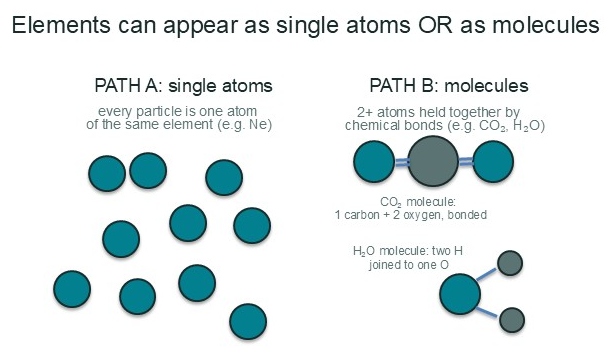
| Feature | Element | Molecule |
|---|---|---|
| Basic Unit | The Atom | A group of two or more bonded atoms |
| Composition | Only one type of atom | Can be one type (e.g., O₂) or multiple types (e.g., H₂O) |
| Representation | Chemical symbol (e.g., Fe, Ne) | Chemical formula (e.g., CO₂, N₂) |
Introducing Compounds
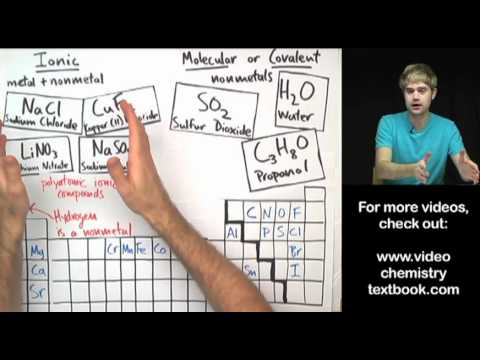 Tyler DeWitt • 7:35
Ionic vs. Molecular (Covalent) Compounds
Core differences in bonding: electron transfer creating ionic crystal lattices vs. electron sharing forming discrete covalent molecules (~7 min).
When molecules are made of atoms from two or more different elements, we classify them more specifically. A compound is a pure substance consisting of two or more different elements chemically bonded together in a fixed ratio. This is exactly the other half of the pure-substance branch on the matter map: like an element, a compound has a fixed, definite composition—water is always two hydrogen
atoms for every one oxygen atom—so it belongs to the 'strong' side of classification. And because the elements in a compound are held together by chemical bonds rather than a physical blend, a compound cannot be separated into its elements by physical means; only a chemical change can tear those bonds apart. The bonds that hold compounds together are fundamentally electrostatic interactions, meaning they are based on the attractions between positive and negative charges. How these charges are distributed leads to two main types of compounds.
Molecule, Compound, or Both?
`Molecule` and `compound` are not interchangeable labels, and the difference comes down to two separate questions: How many atoms are bonded? And how many different elements are involved? Any two or more atoms held together by a chemical bond form a molecule — so O₂, N₂, and H₂ are all molecules — but because each is built from a single element, they are elemental molecules, not compounds. A compound is any pure substance made of two or more different elements in a fixed ratio, and it comes in two structural flavors. A molecular compound — also called a covalent compound — is a compound that IS a molecule: discrete, neutral groups of different atoms held by covalent bonds, like CO₂, H₂O, or CH₄. An ionic compound such as NaCl, by contrast, is NOT a molecule: its oppositely charged ions stack into a repeating three-dimensional lattice, best described by a formula unit, and never form individual molecules. So every molecular compound is a molecule, but not every molecule is a compound — and not every compound is a molecule.
| Substance | How many elements? | A molecule? | A compound? |
|---|---|---|---|
| Neon (Ne) | One — an element | No — single, unpaired atoms | No |
| Oxygen gas (O₂) | One — an element | Yes — two bonded atoms of the same element | No — an elemental molecule, not a compound |
| Water (H₂O) | Two — different elements | Yes — a discrete molecule of bonded atoms | Yes — a molecular (covalent) compound |
| Table salt (NaCl) | Two — different elements | No — an endless lattice of ions, not discrete molecules | Yes — an ionic compound, not a molecular compound |
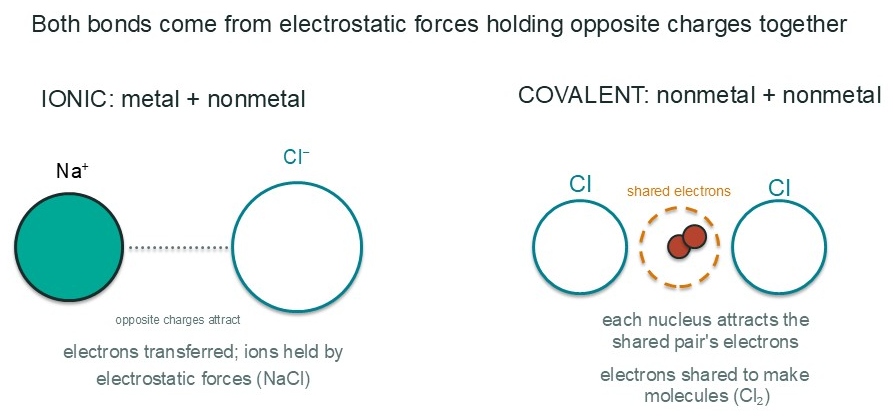
The first type is an ionic compound, typically formed between a metal and a nonmetal. In this bond, one or more electrons are transferred from the metal atom to the nonmetal atom, creating charged particles called ions. The powerful electrostatic attraction between the resulting positive metal ion and negative nonmetal ion forms the bond. The formula unit is the smallest component of an ionic compound—the simplest ratio of positive and negative ions that still retains the compound's identity, and the smallest repeating unit of this crystalline structure. For an ionic compound, the formula unit plays exactly the role a molecule plays for a covalent compound: it is the smallest representative particle. The second type is a covalent (or molecular) compound, which forms when two or more nonmetal atoms share electrons. In this case, the electrostatic attraction is between the shared negative electrons and the positive nuclei of both atoms.
The difference between ionic and covalent bonding explains why sports drinks can help with hydration. They contain ionic compounds (salts called electrolytes) like sodium chloride and potassium chloride. When dissolved in water, these compounds break apart into free-moving ions. These ions are essential for nerve function and muscle contraction, and they help the body absorb water more efficiently than pure water alone.
Properties and Naming Conventions
The type of bonding in a compound dictates its physical properties. The strong attractions in ionic compounds mean they are typically solids at room temperature with very high melting points. Covalent compounds, with weaker forces between their individual molecules, tend to be liquids or gases with much lower melting points. This fundamental difference is why salt and sugar, which look similar, behave so differently when heated.
| Property | Ionic Compounds | Covalent Compounds |
|---|---|---|
| Bonding Type | Electrostatic attraction between ions (metal + nonmetal) | Electron sharing (nonmetals only) |
| Melting Point | High | Low |
| State at 25°C | Usually solid | Often liquid or gas |
| Conducts Electricity? | Only when dissolved in water or molten | Generally does not |
The high melting point of ionic table salt (NaCl, 801 °C) is why it can be used on icy roads without melting itself and why it doesn't burn on a stove. In contrast, covalent table sugar (C₁₂H₂₂O₁₁, melts at 186 °C) easily melts and caramelizes in a hot pan, a process that involves the breakdown of its molecular structure.
To communicate clearly, chemists use a systematic method for naming compounds called nomenclature. The rules depend on whether the compound is ionic or covalent. For covalent (molecular) compounds, we use Greek prefixes to indicate the number of each atom present. For simple ionic compounds, we simply name the metal and then the nonmetal with its ending changed to "-ide".
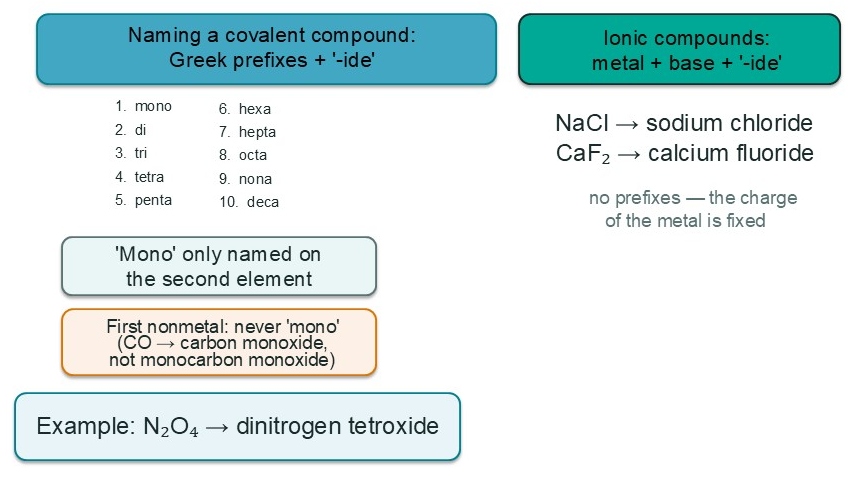
| Number | Prefix |
|---|---|
| 1 | mono- |
| 2 | di- |
| 3 | tri- |
| 4 | tetra- |
| 5 | penta- |
| 6 | hexa- |
| 7 | hepta- |
| 8 | octa- |
| 9 | nona- |
| 10 | deca- |
Worked Example: Naming from Formulas
Scenario: A student needs to write the chemical names for substances with the formulas CO₂, N₂O₄, NaCl, and MgF₂. * CO₂: First, identify the elements. Carbon (C) and Oxygen (O) are both nonmetals, so this is a covalent compound. We use prefixes. There is one carbon and two oxygens. The name is carbon dioxide. We omit the 'mono-' prefix on the first element. * N₂O₄: Nitrogen (N) and Oxygen (O) are both nonmetals, so this is covalent. There are two nitrogens ('di-') and four oxygens ('tetra-'). The name is dinitrogen tetroxide. * NaCl: Sodium (Na) is a metal and Chlorine (Cl) is a nonmetal. This is an ionic compound, so we do not use prefixes. We name the metal (sodium) and the nonmetal with an '-ide' ending (chloride). The name is sodium chloride. * MgF₂: Magnesium (Mg) is a metal and Fluorine (F) is a nonmetal. This is ionic. The name is simply the metal (magnesium) and the nonmetal base with '-ide' (fluoride). The name is magnesium fluoride. The '2' is understood from the charges of the ions and is not stated in the name. The habit to build is to first identify the compound as ionic (metal + nonmetal) or covalent (nonmetals only) before applying the correct naming rule.
Now that we can identify, classify, and name compounds, we are ready to use the mole concept from Unit 2 to count their particles and measure them for chemical reactions.
Practice Questions — Lesson 5
Formulate your answer to each question, then click "Show Solution & Explanation" to review the model solution, conceptual reasoning, and calculations.
Lesson 6: Measuring Matter — The Mole
Imagine you're a baker carefully following a recipe for prize-winning bread. The recipe calls for a specific mass of baking soda (NaHCO₃), which you measure on a digital scale. But the chemical reaction that makes the bread rise doesn't depend on the mass you added; it depends on the number of sodium bicarbonate formula units available to react. A scale measures mass, not a count of particles. So how do chemists and bakers alike bridge the gap between the measurable mass of a substance and the actual number of particles they're working with?
In Unit 2, you met the mole, our fundamental tool for counting atoms and molecules, and you used Avogadro's Number (6.02 x 10²³) as a conversion factor to move between moles and individual particles — converting molecules into moles and back. We treated the mole as a conversion factor, just like a dozen is a conversion factor for eggs. But a balance cannot count particles, and a count of particles cannot be weighed; this lesson adds the missing bridge — molar mass — that connects the measurable mass (grams) on a balance to the number of moles. We will expand the mole into a complete map for navigating the world of chemical quantities, and work with any compound, not just single elements.
From Atomic Mass to Compound Molar Mass
Before you sum any masses, you need to know which mass-scale each number lives on, because a chemist's periodic table reports two closely related but distinct quantities. The atomic mass unit (amu) is the tiny unit of mass reserved for a single particle: one amu is defined as exactly one-twelfth the mass of one carbon-12 atom, which works out to about 1.66 × 10⁻²⁴ grams — so small that no balance can ever weigh it directly. The atomic mass of an element is that element's average particle mass expressed in amu: carbon is 12.01 amu, oxygen is 16.00 amu. It answers the per-particle question, "how heavy is ONE atom?"
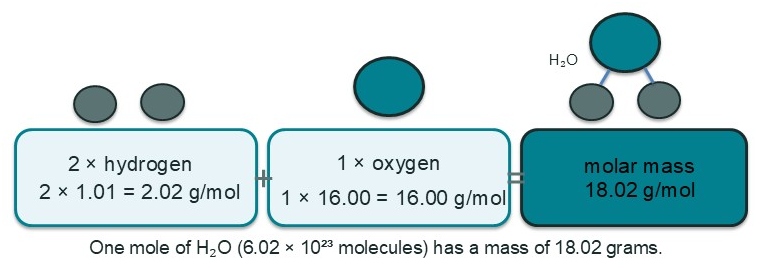
When the particle you are describing is a molecule rather than an element's atom, the same per-particle number gets a new name but keeps the same unit. The molecular mass (used for covalent molecules like H₂O) or formula mass (used for ionic formula units like NaCl) is still measured in amu and still describes ONE particle: a single water molecule has a molecular mass of 18.02 amu (2 × 1.01 for hydrogen + 16.00 for oxygen). The molar mass answers a laboratory-sized question instead — "how many grams does one mole (6.02 × 10²³) of those particles weigh?" — and it is reported in grams per mole (g/mol). For water the molar mass is 18.02 g/mol.
Here is where students get tangled, and here is why the two numbers are so easy to confuse: molar mass and molecular (or atomic) mass are always the same number — 18.02 either way — but they are different quantities measuring different amounts in different units. The link is Avogadro's Number. One amu × 6.02 × 10²³ particles = 1.00 gram, so a single particle's amu mass, multiplied by the mole, lands exactly on the gram-per-mole value: 18.02 amu per molecule × 6.02 × 10²³ molecules = 18.02 g/mol. In short, the amu value describes one particle you will never hold in your hand, while the molar mass describes a heap of 6.02 × 10²³ of them that you can actually weigh out on a balance. When we say "look up the molar mass on the periodic table," we are really reading the atomic mass in amu and letting Avogadro's number silently convert it to grams per mole for us.
| Molecular / atomic mass | Molar mass | |
|---|---|---|
| What it measures | The mass of ONE particle (one atom or one molecule) | The mass of ONE MOLE (6.02 × 10²³ particles) |
| Unit | amu (atomic mass units) | g/mol (grams per mole) |
| Scale | Submicroscopic — about 1.66 × 10⁻²⁴ grams per particle | Laboratory scale — weighable on a balance |
| Same substance, water | 18.02 amu | 18.02 g/mol |
| How to find it | Sum the amu values of each atom in the formula | The identical sum, read as grams per mole |
| Question it answers | "How heavy is a single particle?" | "How many grams do I weigh out in the lab?" |
| The bridge | Multiply by 6.02 × 10²³ (Avogadro's Number) | The mole converts amu-per-particle into grams-per-mole |
The same relationship that works for a single element extends to any compound, on the compound's own mole. The molar mass of a compound is the mass in grams of one mole of its molecules or formula units, found by summing the molar masses of all the atoms in its chemical formula — read each element's atomic mass off the periodic table, treat it as g/mol, and add. This works because of the Law of Definite Proportions, which states that a given chemical compound always contains its component elements in a fixed ratio by mass. The formula H₂O therefore means the same 2:1 hydrogen-to-oxygen atom ratio — and the same 18.02 g/mol — for every water sample you ever measure, whether it comes from a lab faucet or an Antarctic glacier.
Worked Example: Moles in a Dose of Aspirin
A standard aspirin tablet contains 325 mg of its active ingredient, acetylsalicylic acid (C₉H₈O₄). To determine how many moles of aspirin you are taking, you first need its molar mass. By summing the masses of its atoms from the periodic table, we find the molar mass is 180.17 g/mol. Now we can use dimensional analysis to convert the mass from the tablet into moles, making sure our units are consistent.
Milligrams cancel with milligrams in the first fraction, and intermediate grams cancel diagonally in the second fraction on 2 separate lines, isolating moles of active aspirin ingredient.
Pharmacists live by molar mass. The human body responds to the number of molecules of a drug, not its mass. A 200 mg dose of ibuprofen (C₁₃H₁₈O₂, molar mass 206.29 g/mol) and a 325 mg dose of aspirin (C₉H₈O₄, molar mass 180.17 g/mol) deliver a different number of molecules to your system. Calculating moles allows for precise, effective, and safe drug formulation and dosing.
The Mole Map: Connecting Mass, Particles, and Volume
 Tyler DeWitt • 8:18
Converting Between Grams and Moles
Tyler DeWitt explains how to write 2-line conversion fractions that cancel units properly (~8 min).
 Tyler DeWitt • 9:32
Converting Between Moles, Atoms, and Molecules
Master using Avogadro's number (6.022 × 10<sup>23</sup>) in dimensional analysis chains (~9 min).
Think of the mole as the central hub of a transportation system. From Unit 2, you already have one road: the one connecting moles to the number of particles (using
Avogadro's Number). This lesson adds a second road connecting mass (grams) to moles using molar mass, and we will end with a third destination: for gases, their volume (in liters). This creates a complete "mole map" that allows you to convert between any of these fundamental quantities.
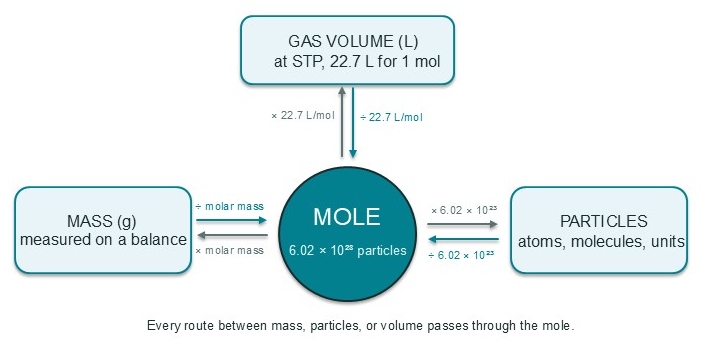
The newest road on our map connects moles of a gas to its volume. This relationship is described by Avogadro's Law, which states that equal volumes of any gases, at the same temperature and pressure, contain an equal number of molecules. This gives us an incredibly useful new conversion factor: at Standard Temperature and Pressure (STP: 0°C and 1 bar), one mole of any ideal gas has a volume of 22.7 liters. This value is known as the standard molar volume.
The mole is the universal currency in chemistry. Just as the dollar allows us to compare the value of apples and cars, the mole allows us to relate a measurable mass of a solid on a balance, the volume of a gas in a balloon, and the invisible count of atoms reacting in a beaker. This concept turns recipes into predictable, quantitative science, essential for everything from manufacturing fertilizers to developing new medicines.
Measuring Mass by Volume: The Density Triangle
Before the mole turns a recipe into quantities, one more measurement tool deserves a spot in every lab bench toolkit: density. Density is the amount of mass packed into a given volume, reported in g/mL or g/cm³, and because it is a physical property (a substance's characteristic that you met in Lesson 1), the same pure substance always has the same density no matter how much of it you take. Gold's high density is why a small gold bar feels so heavy, while water's density of 1.00 g/mL is why a liter of water masses almost exactly one kilogram. The density triangle organizes the three quantities—mass (M) on top, density (D) and volume (V) at the bottom corners—so that covering the quantity you want reveals the operation: M = D × V, D = M ÷ V, and V = M ÷ D.
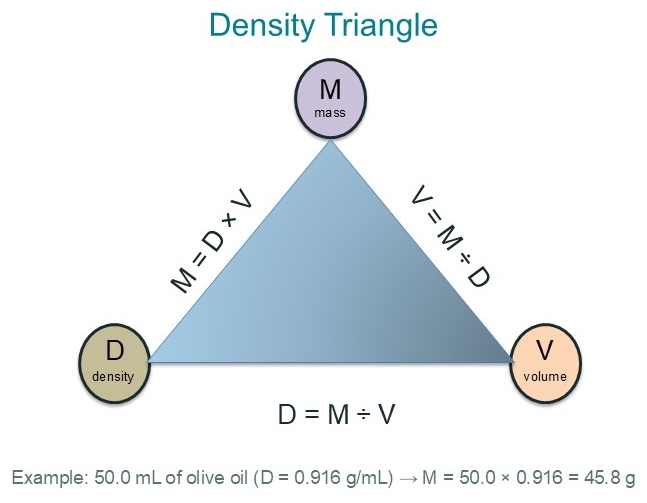
Read the triangle exactly the way it sounds: place your finger over the quantity you are solving for, and the two visible terms show you the formula and the operation. Need mass? M sits above D and V, so multiply: M = D × V. Need density or volume? The missing corner sits below the dividing bar, so divide: D = M ÷ V and V = M ÷ D. Always check that the units cooperate too—grams divided by milliliters gives g/mL, and multiplying g/mL by mL cancels the milliliters to leave grams, a factor-label habit you have sharpened since Unit 2.
Worked Example: Measuring a Recipe's Oil by Volume
Scenario: A recipe asks for 50.0 mL of olive oil, but the balance is busy and the recipe's real requirement is the mass of oil that goes into the mixture. Olive oil has a density of 0.916 g/mL—a physical property that can simply be looked up. On the density triangle, cover M, which tells you to multiply density by volume, then set up the conversion.
Milliliters in the denominator cancel milliliters in the numerator on 2 separate lines, directly yielding mass in grams.
The habit to build is to treat density as a ready-made conversion factor: when a substance's density is known, a volume reading from a graduated cylinder and a mass from a balance become interchangeable within seconds. The same triangle works in reverse—if a procedure demands a precise mass but you only have a volume, measure the volume instead and let density convert it for you. Wines, honey, paints, and medicines are dosed and priced by volume or by mass according to whichever is more convenient, precisely because density connects the two.
Bakers and pharmacists lean on this trick constantly. A honey recipe written in cups is really a mass recipe: honey's density is about 1.42 g/mL, so one cup (236.6 mL) of honey masses roughly 336 g—far heavier than the same cup of water. Liquid medicines, paints, and even jet fuel are standardized the same way, converting between what you can pour (volume) and what the chemistry actually needs (mass) using the characteristic density of the substance.
Putting It All Together: Multi-Step Conversions
Worked Example: From Gas Volume to Mass
Scenario: A large weather balloon is filled with 448 L of Helium (He) gas at STP. What is the mass of the helium in the balloon? To solve this, you must trace a path on the mole map: Liters → Moles → Grams. First, convert the volume of gas to moles using the standard molar volume.
With the amount in moles now known, the next step is to convert from moles to mass using the molar mass of Helium from the periodic table (4.00 g/mol).
Both liters (L) and intermediate moles (mol) cancel diagonally across the 2-line conversion chain, leaving only grams of helium.
The habit to build is to always trace your path on the mole map, using a separate conversion factor for each step. Don't try to jump across the map without going through the central hub: the mole. This methodical process of checking your units at each stage is the surest way to a correct answer.
With this complete map, you can now confidently convert between the mass, particle count, and gas volume for any substance. This skill is the absolute foundation for stoichiometry, the subject of our next lessons, where we will use mole ratios from balanced chemical equations to quantitatively describe chemical reactions.
Practice Questions — Lesson 6
Formulate your answer to each question, then click "Show Solution & Explanation" to review the model solution, conceptual reasoning, and calculations.
First, convert milligrams to grams: 250 mg = 0.250 g. Next, use the mole map to convert grams to moles, and finally moles to molecules:
Grams and intermediate moles cancel on separate lines across the conversion chain. Limited to three significant figures.
The conversion from gas volume at STP to moles uses the standard molar volume of 22.7 L/mol:
Liters cancel in the denominator, leaving moles of gas. Limited to two significant figures.
This is a two-step conversion: grams → moles → liters. First find molar mass of diatomic nitrogen: 2 × 14.01 = 28.02 g/mol.
Both grams and intermediate moles cancel cleanly on 2 separate lines.
Step 1: Convert measured moles of pure NaCl into theoretical mass using molar mass (58.44 g/mol):
Moles cancel out, yielding the theoretical pure mass.
Step 2: Calculate mass percent purity:
Lesson 7: Chemical Equations and Stoichiometric Coefficients
Picture the blue flame calmly rising from your kitchen gas burner on a quiet morning. Beneath that flame, natural gas is performing a chemical reaction that never shows up on any recipe card: methane combines with oxygen from the air and is transformed into carbon dioxide and water vapor. The flame isn't random, though — the same numbers of the same atoms cooperate every single time. Chemists write reactions as shorthand so they can say exactly what those numbers are, and once you can read that shorthand, you can count what reacts and what is produced with total confidence.
All of chemistry's shorthand fits on one line. A chemical equation is a written description of a reaction that shows which substances change and which substances are produced. The substances that are present at the start, on the left side of the arrow, are called reactants; the substances produced, on the right side of the arrow, are called products; and the arrow itself is read as "yields." The burner above can be written as:
CH₄ + 2O₂ → CO₂ + 2H₂O
Anatomy of a Chemical Equation: Coefficients and Subscripts
 Tyler DeWitt • 15:05
Balancing Chemical Equations Practice Problems
Tyler DeWitt teaches the systematic inventory method for balancing coefficients without ever changing formula subscripts (~15 min).
Every term in a chemical equation carries two kinds of numbers, and confusing them is the single most common error students make. A subscript is the small number written after an element symbol; it belongs permanently to that molecule, because it states how many of that atom are bonded inside ONE molecule or formula unit. In H₂O, the subscript 2 is part of the chemical identity of water itself. A stoichiometric coefficient is the larger number written in front of a formula; it counts how many whole molecules, formula units, or atoms of that substance take part in the reaction. In 2H₂ + O₂ → 2H₂O, the coefficient 2 in front of H₂ means two separate hydrogen molecules participate, while the subscript 2 inside each H₂ is an unchangeable part of the hydrogen molecule itself.
| Feature | Subscript | Stoichiometric Coefficient |
|---|---|---|
| What it counts | Atoms inside a single molecule or formula unit | Whole molecules, formula units, or atoms taking part in the reaction |
| Where it lives in 2H₂O | The 2 after H — written small, below the line: H₂ | The 2 in front — written on the line, before the formula: 2H₂O |
| What happens if you change it | You create a different substance (H₂O becomes H₂O₂) | You change how much of the same substance reacts, not what it is |
| How many atoms it describes | Exactly its value: H₂ always means precisely 2 hydrogen atoms | Its value times the formula: 2H₂O means 2 copies of H₂O, so 4 H atoms and 2 O atoms |
Because matter can neither be created nor destroyed during an ordinary reaction, the numbers must obey the Law of Conservation of Mass: the total count of each kind of atom on the left must equal the total count on the right. An equation that satisfies this rule is called a balanced chemical equation. In CH₄ + 2O₂ → CO₂ + 2H₂O, counting each element proves it: the left has 1 carbon, 4 hydrogens, and 4 oxygens, and the right has the exact same 1 carbon, 4 hydrogens, and 4 oxygens — just rearranged into new molecules. To keep an equation balanced, chemists adjust the coefficients and never the subscripts, because changing a subscript would change the identity of the substance itself.
One Equation, Two Scales: Particles and Moles
Here is the idea that makes coefficients so powerful: the same number in front of a formula works at two completely different scales at once. On the microscopic scale, 2H₂ + O₂ → 2H₂O says that two hydrogen molecules and one oxygen molecule react to make two water molecules. On the macroscopic scale, the identical number says that two moles of hydrogen molecules and one mole of oxygen molecules react to make two moles of water molecules. Nothing changes but the unit you count in — a mole is just Avogadro's Number (6.02 × 10²³) of whatever you are counting, a connection you first built in Unit 2 and refined in the last lesson.
The coefficient is the same because you can multiply the entire equation by Avogadro's Number without changing the ratio between any of the substances. Magnify 2H₂ + O₂ → 2H₂O by 6.02 × 10²³ and you get 2 mol H₂ + 1 mol O₂ → 2 mol H₂O, which is the recipe you could actually weigh out on a balance. In other words, the coefficients always give you the fixed ratio of particles, and that same ratio is automatically the fixed ratio of moles. The coefficient 2 means 2 molecules OR 2 moles, never 2 total atoms — the atoms are counted only by the subscripts inside each molecule.
Worked Example: Read the Recipe Out Loud
Scenario: A student is asked to describe the reaction CH₄ + 2O₂ → CO₂ + 2H₂O in words. Student A reads it at the particle scale: "One molecule of methane reacts with two molecules of oxygen to produce one molecule of carbon dioxide and two molecules of water." Student B reads the exact same equation at the mole scale: "One mole of methane reacts with two moles of oxygen to produce one mole of carbon dioxide and two moles of water." Student C worries that the numbers must mean individual atoms: "The 2 in front of O₂ makes it four oxygen atoms, and the 2 in front of H₂O makes two waters... I'm not sure what to do with the leftover atoms after the reaction." The habit to build is to read the equation twice — once with the word "molecules" and once with the word "moles" — and to remember that only subscripts, never coefficients, tell you the number of atoms inside each particle.
Car airbags rely on reading exactly this double meaning. When a crash sensor fires, sodium azide decomposes according to 2NaN₃ → 2Na + 3N₂: two formula units of sodium azide break apart to release three molecules of nitrogen gas. At the mole scale, two moles of sodium azide blast out three moles of nitrogen — 1.8 × 10²⁴ gas molecules, enough to inflate the bag in roughly 30 milliseconds. Engineers who designed the sensor and the canister did the entire design on the mole reading of that one line.
Coefficients Are Fixed Ratios: A Glimpse of Stoichiometry
Because the coefficients never change for a given reaction, they form a permanent ratio between the substances involved. In CH₄ + 2O₂ → CO₂ + 2H₂O the ratio is 1 : 2 : 1 : 2 — one part methane to two parts oxygen to one part carbon dioxide to two parts water, whether you count molecules or moles. This fixed ratio, called a mole ratio, is the single most valuable number a chemical equation can give you: it tells you how much of each reactant is needed and how much of each product will form. Doubling the methane doubles the carbon dioxide and the water; halving the batch halves the products, exactly the way a cookie recipe scales when you invite more guests.
You already have every tool needed to work with these ratios: from the last lesson you can convert between grams and moles for any substance using its molar mass, and you can find the molar mass of an entire compound. From Unit 2 you already know how to convert between moles and individual particles using Avogadro's Number. What the coefficients add is the bridge between one substance and another — the statement that 1 mol of O₂ always consumes 1 mol of CH₄ and produces 1 mol of CO₂. Putting those skills together is the entire job of stoichiometry, the topic you will meet soon; this lesson's only job is to make the coefficients themselves feel familiar and trustworthy.
Worked Example: Counting from the Coefficient
Scenario: A chemistry club wants to know how much hydrogen, in moles, the coefficient 2 in 2H₂ represents, if they could count out 1.204 × 10²⁴ hydrogen molecules. Recalling that one mole holds Avogadro's Number of particles, they set up the familiar factor-label conversion from Unit 2.
Molecules cancel on 2 separate lines, directly confirming that the coefficient 2 corresponds to 2.00 moles.
The conversion confirms the coefficient: two of anything, counted by the mole, is exactly 2.00 moles. Now let the coefficients answer a question about the reaction itself: if one mole of oxygen reacts completely in 2H₂ + O₂ → 2H₂O, how many moles of water are produced? The coefficients say 1 O₂ produces 2 H₂O, so the ratio is two waters for every one oxygen.
Reacted oxygen moles cancel in the denominator, converting through the stoichiometric mole ratio (2 : 1) into water produced.
The habit to build is to treat the coefficients as a built-in conversion factor: the ratio from the equation tells you how the moles of different substances are connected. Stoichiometry will train you to chain several of these ratios together; for now, simply notice that every piece of the chain — grams to moles (Lesson 6), moles to moles, moles to particles (Unit 2) — is a factor-label conversion you already know how to perform.
Industry runs on mole ratios. The Haber process, which produces the ammonia used in most nitrogen fertilizers, runs the reaction N₂ + 3H₂ → 2NH₃ at enormous scale: three moles of hydrogen are needed for every one mole of nitrogen, and buying extra hydrogen by accident is not a rounding error but a multi-thousand-dollar daily expense. Chemists and chemical engineers decide how much of each chemical to order, store, and pump by reading the coefficients as mole ratios — understanding today what the coefficients mean is literally the difference between a plant that makes fertilizer profitably and one that burns money.
Without looking back, write 2H₂ + O₂ → 2H₂O in words at the particle scale and again at the mole scale. Then count the total atoms of hydrogen and oxygen on each side. If your two readings differ only by the word "mole," and your atom counts match on both sides, you have the two ideas of this lesson working together.
With coefficients unlocked, you now know that a chemical equation is not a vague description but a precise set of numbers that works in the invisible world of molecules and the weighable world of moles at the same time. Wherever this unit will take you next — balancing reactions, measuring out reactants in the lab, even designing industrial processes — these numbers will be right there in the recipe, calculating every quantity the equation promises.
Practice Questions — Lesson 7
Formulate your answer to each question, then click "Show Solution & Explanation" to review the model solution, conceptual reasoning, and calculations.
The coefficients give the stoichiometric mole ratio: 3 mol Cl<sub>2</sub> : 2 mol Al:
Moles of Al cancel in the denominator on 2 separate lines, yielding moles of chlorine gas.
Step 1: Convert grams of water to moles using molar mass (18.02 g/mol):
Grams cancel, giving moles of water product.
Step 2: Use the mole ratio from the balanced equation (2 mol H<sub>2</sub> : 2 mol H<sub>2</sub>O):
Key Vocabulary & Comprehensive Glossary
Type any scientific term or keyword to filter the complete Unit 3 glossary instantly:
A negatively charged ion, often forming in nonmetals. It forms when an atom or molecule gains one or more electrons, resulting in an imbalance where there are more electrons (negative charges) than protons (positive charges).
The smallest unit of an element that retains the chemical properties of that element. Composed of protons and neutrons in the nucleus and surrounded by electrons.
Standard unit of mass used to represent the mass of atoms and molecules. It is defined as 1/12 of a carbon-12 atom (1.66054 x 10⁻²⁴ g). It is also known as the unified atomic mass unit (u) or the Dalton (Da).
The number of protons in the nucleus of an atom. It is indicated on the top of an element symbol on the periodic table of elements. The periodic table is organized by increasing atomic number.
The weighted average of the atomic masses of all naturally occurring isotopes of an element, taking into account the relative abundance of each isotope. The average atomic mass is typically expressed in atomic mass units (amu).
Equal volumes of all gases, at the same temperature and pressure, contain the same number of molecules. This means that the volume of a gas is directly proportional to the number of moles (or molecules) of the gas, as long as the temperature and pressure remain constant. 1 mole of a gas = 22.7 L
A fundamental concept in chemistry, equal to 6.022 x 10²³. It represents the number of atoms, molecules, or other particles in one mole of a substance, and is named after the Italian scientist Amedeo Avogadro. This number is crucial for converting between the macroscopic world of grams and the microscopic world of atoms and molecules.
A chemical equation in which the total number of atoms of each element is the same on both sides of the arrow, satisfying the Law of Conservation of Mass.
Also called vaporization, boiling is the process where a liquid transforms into a gas (vapor). This occurs when its vapor pressure equals the surrounding pressure, typically the atmospheric pressure. This phase transition occurs throughout the liquid when the boiling point is reached.
A positively charged ion, often forming in metals. It forms when an atom or molecule loses one or more electrons, resulting in an imbalance where there are more protons (positive charges) than electrons (negative charges).
Strong electrostatic interactions specifically between oppositely charged ions, between atomic nuclei and electrons to create molecules or compounds, or between metal ions and their electrons within metals.
A written shorthand for a chemical reaction that lists the reactants on the left of an arrow and the products on the right. It shows which substances are consumed and which are produced, and how much of each participates.
A characteristic of a substance that can be observed or measured only during a chemical reaction or change, where the substance's chemical composition is altered. It describes how a substance behaves when it interacts with other substances.
A separation technique that isolates the individual components of a mixture by utilizing the different forces that occur between the substances in the mixture. The mixture is distributed through a mobile phase and a stationary phase. The components of the mixture interact differently with these two phases, causing them to travel at different speeds and thus separate from one another.
A heterogeneous mixture with particle sizes of 2-1000 nm. The mixture may appear homogeneous, but is microscopically heterogeneous. A colloid will scatter light due to the presence of larger particle sizes.
A substance formed through the chemical bonding of two or more elements in a fixed ratio. They can only be separated into their substituent atoms through chemical rather than physical means. Compounds can be ionic or covalent depending on the type of atom and chemical bond between atoms.
The change of state from a gas to a liquid. It's the opposite of evaporation, where a liquid turns into a gas. This phase transition occurs when gas molecules lose energy, slow down, and cause a liquid to form due to an increase in the forces between molecules.
A ratio expressed as a fraction that equals 1. When we use conversion factors to convert units, we multiply our original measurement by the conversion factor to get the same measurements expressed in new units.
A chemical compound composed of molecules that have atoms held together by strong electrostatic forces between electrons and nuclei on adjacent atoms. However, these molecules also have weak electrostatic forces between them, resulting in low melting and boiling points. They are characterized by low thermal and electrical conductivity.
A process used to separate mixtures, specifically those containing a solid and a liquid or two immiscible liquids, by carefully pouring off the top layer after allowing the components to settle. This method relies on the difference in densities between the substances, where the denser component settles to the bottom and the less dense component forms a layer on top.
The phase transition where a gas directly transforms into a solid without becoming a liquid first, often occurring when a gas cools quickly.
A molecule composed of two atoms of the same element, chemically bonded together. These elements are always found in pairs because their atoms tend to form stable molecules with each other.
A separation technique that uses differences in boiling points to purify or separate components of a liquid mixture. The process involves heating the mixture, which causes the component with the lower boiling point to vaporize. This vapor is then cooled and condensed back into a liquid, leaving the higher-boiling component behind.
The ability of a substance, typically a metal, to deform under tensile stress (being pulled or stretched) and be drawn into a wire or elongated without breaking. It’s the property that allows a material to be stretched thin without fracturing.
A subatomic particle found outside of the nucleus of an atom that are involved in chemical bonding and contributes to the chemical nature of the atom. It carries a negative electrical charge equal in magnitude but opposite to that of a proton. It does not contribute significantly to the overall mass of the atom.
The force of attraction or repulsion between electrically charged particles, including atoms, ions, and molecules. Like charges repel, while opposite charges attract. These interactions are fundamental in determining molecular structure, behavior, and chemical bonding.
A substance made up of only one type of atom. It can refer to one atom or a group of the same atoms. They cannot be broken down into simpler substances through chemical reactions. They are represented by one or two letter symbols on the periodic table.
The process where a liquid changes into a gas (vapor) below its boiling point. It's a phase transition that occurs at the surface of a liquid when individual molecules gain enough energy to overcome the attractive forces holding them together in the liquid state.
A separation technique used to separate a soluble solid from a liquid in a solution by heating the mixture until the liquid evaporates, leaving the solid behind. This method is particularly effective for separating a solid solute from a liquid solvent in a homogeneous mixture.
A technique used to separate solid particles from a liquid or gas by passing the mixture through a filter medium that retains the solid particles while allowing the fluid to pass through. The solid material that is trapped by the filter is called the residue, and the liquid or gas that passes through is called the filtrate.
The simplest ratio of ions in a solid ionic compound. It represents the smallest unit of such a substance that still retains the compound's properties. Unlike molecular compounds, ionic compounds don't exist as discrete molecules, so "formula unit" replaces "molecule" when referring to them.
The phase transition where a liquid turns into a solid due to a decrease in temperature. This process occurs when the molecules of a liquid lose enough kinetic energy (heat) to allow forces between molecules to draw them into fixed positions, forming a crystalline solid structure.
A state of matter characterized by having neither a definite shape nor a definite volume. Gases are composed of particles (atoms or molecules) that are widely separated and in constant, random motion, leading to properties like compressibility and the ability to fill any container they occupy.
A mixture with unevenly-sized particles greater than 1 nm that may be visually distinguished. Solids, liquids, or gases are dispersed in a dispersion medium. Heterogeneous mixtures may have visibly different components and/or phases. A heterogeneous mixture has a non-uniform composition and uneven properties throughout.
A mixture with small (less than 1 nm), even-sized particles and has a uniform composition and properties throughout.
International Union of Pure and Applied Chemistry. IUPAC is the authority on chemical nomenclature and terminology. It establishes specific, uniform, and consistent chemical definitions as well as standards and conventions for presenting data.
An atom or molecule that has gained or lost one or more electrons, resulting in a net electrical charge.
A chemical compound composed of ions held together by strong electrostatic forces. These bonds form from attraction between oppositely charged ions to create a stable crystal lattice structure. These compounds are characterized by high densities, high melting and boiling points, and low thermal and electrical conductivity in their solid form (high conductivity when in a solution).
Atoms with the same identity (same number of protons) but different number of neutrons, resulting in different atomic masses. Isotopes have the same chemical properties, but different physical properties. The weighted abundance of isotopes defines the relative atomic mass of atoms.
The energy an object possesses due to its motion. It's the energy of moving particles, like molecules, and is directly related to their mass and velocity.
Also called particle theory, it explains the behavior of matter by describing it in terms of the motion and properties of its constituent particles. It postulates that particles are in constant, random motion, and that their kinetic energy is related to temperature. The theory helps explain macroscopic properties of gases like pressure, temperature, and volume by relating them to the microscopic behavior of particles.
The principle that matter is neither created nor destroyed in a chemical reaction, so the total mass and the total count of each kind of atom on the reactant side must exactly equal those on the product side. It is the reason chemical equations must be balanced.
Also known as Proust's Law or the Law of Constant Composition, states that a chemical compound always contains the same elements in the same proportions by mass, regardless of the source or method of preparation. It means the ratio of the masses of the elements in a compound is always fixed.
A state of matter that has a definite volume but not a definite shape. It takes the shape of its container. Liquids are characterized by their ability to flow and their relatively high density compared to gases.
The ability of a substance, typically a metal, to be deformed under pressure (compressive stress) and hammered or rolled into thin sheets without breaking. This property allows materials to be reshaped without losing their structural integrity.
The number of protons and neutrons in the nucleus of an atom. It is different depending on the isotope of the element.
The process where a substance changes from a solid to a liquid state, typically due to the application of heat. This phase transition occurs when the molecules of the solid absorb enough energy to overcome the attractive forces holding them in a fixed structure, allowing them to move past each other as a liquid.
A substance that is characterized by properties like luster, malleability, and high electrical and thermal conductivity. Metals are typically solids at room temperature, located on the left and in the middle of the periodic table, and tend to lose electrons, forming cations. Metals can form chemical bonds with nonmetals to form ionic compounds, as well as other metals in alloys.
A chemical element exhibiting properties intermediate between those of metals and nonmetals, sometimes referred to as semimetals. Metalloids are typically found along the "stair-step" line on the periodic table, separating metals from nonmetals. They form bonds with nonmetals, forming covalent compounds.
Composed of two or more substances that are physically mixed, but do not contain chemical bonds between the individual substances. The proportions can vary, depending on the mixture. The substances retain their chemical identities and can be separated by physical means.
A liquid solvent that carries a sample through a chromatographic system. This liquid moves the sample components through a stationary phase, allowing for separation based on differences in their interactions with the two phases.
The mass of one mole of a substance, typically expressed in grams per mole (g/mol). It represents the mass of 6.022 x 10²³ representative particles (atoms, molecules, ions, etc.) of that substance. Essentially, it's the atomic or molecular weight of a substance expressed in grams.
A unit of measurement that represents a specific quantity of a substance, specifically 6.022 x 10²³ entities (atoms, molecules, ions, etc.). The mole allows chemists to work with macroscopic amounts of substances (like grams) while still relating it to the microscopic world of atoms and molecules.
The fixed ratio between the amounts of two substances in a balanced chemical equation, taken from their stoichiometric coefficients and expressed in moles. It acts as a conversion factor between the substances and is the foundation of stoichiometry.
The sum of the atomic masses of all atoms in a single molecule. It's a relative mass, often expressed in atomic mass units (amu) or Daltons (Da), and represents the mass of one molecule of a substance.
A group of two or more atoms (can be the same or different) held together by chemical bonds.
A subatomic particle found in the nucleus of an atom that contributes to the overall atomic mass. It is assigned a relative mass of 1 amu. It does not carry an electric charge, so is considered electrically neutral.
Chemical elements that generally lack the typical properties of metals, such as high electrical conductivity, luster, and malleability. They are typically poor conductors of heat and electricity, and exist as brittle solids, liquids, or gases at room temperature. They tend to gain electrons, forming anions, and form chemical bonds with metals to make ionic compounds. They can also form bonds with other nonmetals to form covalent compounds.
The dense, positively charged central region of an atom that consists of protons and neutrons. It contributes to almost all of the mass of an atom, but only a small fraction of its total volume.
A characteristic of a substance that can be observed or measured without changing the substance's chemical identity. These properties describe the substance's physical state and appearance.
An ionized gas where a significant portion of the particles are electrically charged (ions and electrons) due to sufficient energy being added to a gas. This ionization means that some electrons are stripped away from their atoms, resulting in a mixture of ions and free electrons. Plasma is the most abundant state of matter in the universe, with stars, nebulae, and the space between galaxies all composed of plasma. On Earth, plasma can be found in lightning, neon signs, and even the very hot part of a flame.
A substance that is produced by a chemical reaction. Products appear on the right side of the arrow in a chemical equation.
A subatomic particle found in the nucleus of an atom that defines an element’s identity. It carries a positive electrical charge equal in magnitude but opposite to that of an electron. It is assigned a relative mass of 1 amu.
Matter with a uniform and constant composition, consisting of only one type of atom, molecule, or compound. It has specific, unique chemical and physical properties.
A substance that is present at the start of a chemical reaction and is consumed as the reaction proceeds. Reactants appear on the left side of the arrow in a chemical equation.
A separation technique that relies on differences in particle size to separate components of a mixture. It involves passing the mixture through a sieve, which is a tool with openings of a specific size. Particles smaller than the openings pass through, while larger particles are retained on the sieve.
A state of matter characterized by a definite shape and volume, where particles are tightly packed together, resisting compression and flow.
The component present in a smaller amount that gets dissolved by another substance (solvent) to form a solution.
A specific type of homogeneous mixture where a solute is dissolved in a solvent (solid or liquid). Particles are evenly distributed and the solution has unique chemical and physical properties that differ from the individual component substances.
A solid or liquid component present in a larger amount that dissolves another substance (solute) to form a solution.
A solid or a liquid that is coated on a solid, that remains fixed in place within the chromatography system, while the mobile phase flows over or through it. It interacts differently with the various components of a mixture, causing them to separate as they move through the system.
The number written in front of a formula in a chemical equation that counts how many whole molecules, formula units, or atoms of that substance take part in the reaction. The same coefficient also counts the number of moles of that substance, so it can be read at both the particle scale and the mole scale.
Particles smaller than and are the fundamental building blocks of atoms. The three main subatomic particles are protons, neutrons, and electrons.
The transition of a substance directly from the solid phase to the gaseous phase, bypassing the liquid phase. This occurs when the solid's vapor pressure exceeds the surrounding pressure, allowing molecules to escape directly into the gas state.
A small number written after an element symbol in a chemical formula that states how many atoms of that element are bonded inside one molecule or formula unit. It is a permanent part of the substance's identity and is never changed to balance an equation.
A heterogeneous mixture consisting of solid particles suspended in a liquid. Solid particle sizes are >1000 nm, causing them to settle over time due to gravity. They often appear cloudy due to suspended particles.
The scattering of a beam of light as it passes through a colloidal dispersion. This occurs because the particles in a colloid are large enough to scatter the light, making the light beam visible as it passes through the mixture. In contrast, a true solution with much smaller particles does not exhibit the Tyndall effect, as the light passes through without being scattered.
The tendency of a substance to evaporate and is a measure of how easily a substance transitions into a gaseous state. A measure of the pressure exerted by a gas on its condensed phase in a closed container.
Official Model Answer Key — All Lessons
Comprehensive model solutions with step-by-step mathematical setups, unit cancellation fractions, and conceptual justifications.
Lesson 1 Practice Questions Model Solutions
(b) It is likely a mixture. The calculated density (0.786 g/mL) is close but different from the accepted value for pure acetone (0.7845 g/mL). Since density is a characteristic physical property of a pure substance, a deviation like this often indicates the presence of impurities, which would make the sample a mixture.
Lesson 2 Practice Questions Model Solutions
Convert sample volume to liters:
Next, calculate dissolved salt mass from salinity (35.0 g/L):
Lesson 3 Practice Questions Model Solutions
The calculation requires a three-step factor-label conversion: grams of Si → moles of Si → atoms of Si → total protons:
Grams, moles, and individual atoms cancel diagonally on 2 separate lines, yielding total nuclear protons.
Lesson 4 Practice Questions Model Solutions
Oxygen is one of the seven diatomic elements (BrINClHOF), so its formula is O<sub>2</sub> with a molar mass of 2 × 16.00 = 32.00 g/mol:
Grams cancel diagonally on 2 separate lines. Limited to three significant figures.
Lesson 5 Practice Questions Model Solutions
Lesson 6 Practice Questions Model Solutions
First, convert milligrams to grams: 250 mg = 0.250 g. Next, use the mole map to convert grams to moles, and finally moles to molecules:
Grams and intermediate moles cancel on separate lines across the conversion chain. Limited to three significant figures.
The conversion from gas volume at STP to moles uses the standard molar volume of 22.7 L/mol:
Liters cancel in the denominator, leaving moles of gas. Limited to two significant figures.
This is a two-step conversion: grams → moles → liters. First find molar mass of diatomic nitrogen: 2 × 14.01 = 28.02 g/mol.
Both grams and intermediate moles cancel cleanly on 2 separate lines.
Step 1: Convert measured moles of pure NaCl into theoretical mass using molar mass (58.44 g/mol):
Moles cancel out, yielding the theoretical pure mass.
Step 2: Calculate mass percent purity:
Lesson 7 Practice Questions Model Solutions
The coefficients give the stoichiometric mole ratio: 3 mol Cl<sub>2</sub> : 2 mol Al:
Moles of Al cancel in the denominator on 2 separate lines, yielding moles of chlorine gas.
Step 1: Convert grams of water to moles using molar mass (18.02 g/mol):
Grams cancel, giving moles of water product.
Step 2: Use the mole ratio from the balanced equation (2 mol H<sub>2</sub> : 2 mol H<sub>2</sub>O):